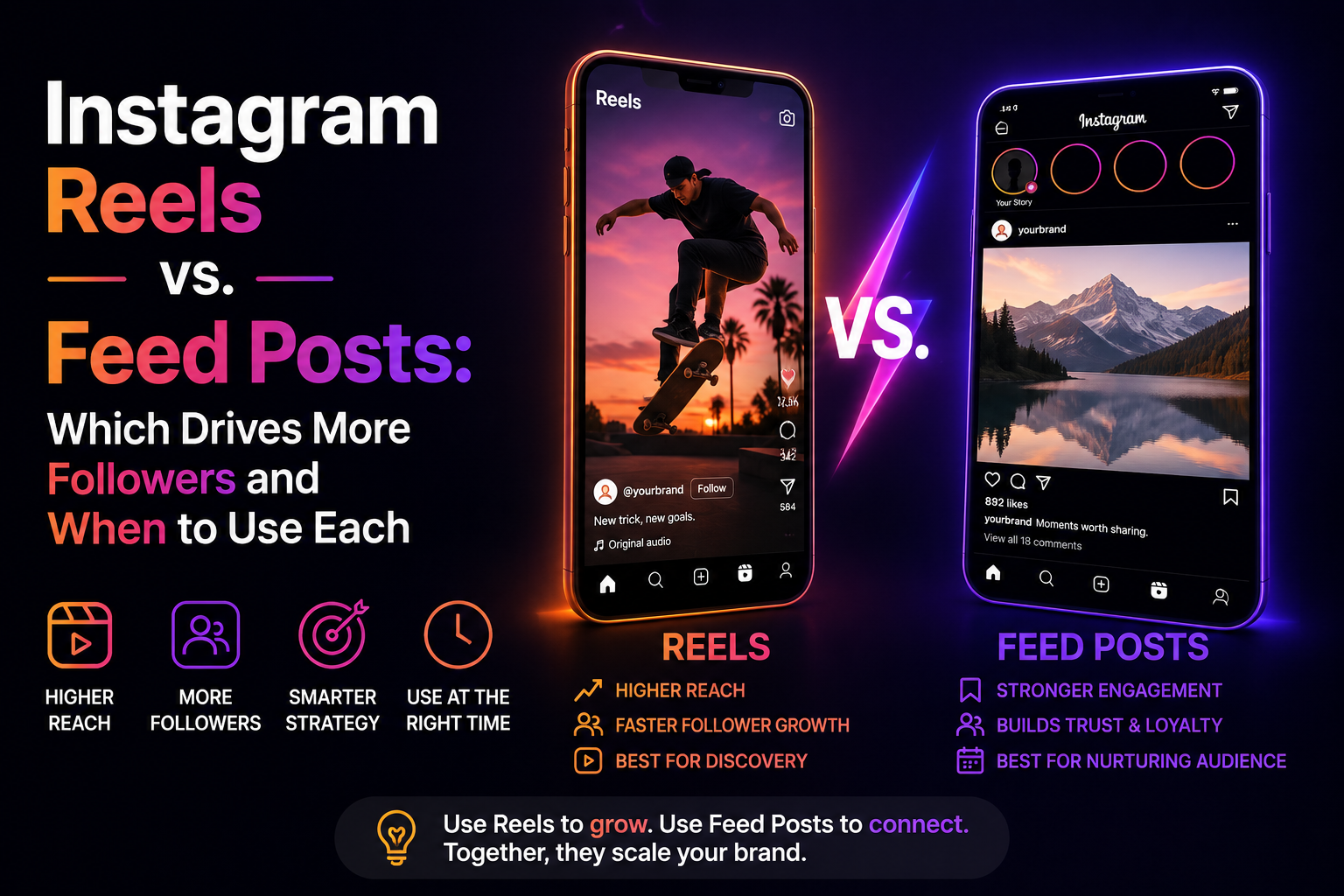
This guide breaks down the actual differences between the two formats in 2026, which drives more follower growth, when to prioritize each, and how audience quality affects performance across both.
How Reels and Feed Posts Differ Algorithmically
The fundamental difference between Reels and feed posts is their distribution logic:
This single distinction explains most of the strategic difference between the two formats: Reels are a growth tool, feed posts are a retention and depth tool.
Which Format Drives More New Followers
Reels consistently drive more new followers than feed posts. The reasons are structural:
For accounts in growth mode — building follower count from scratch or recovering after a plateau — Reels should be the primary content investment.
When Feed Posts Outperform Reels
Despite Reels' advantage for follower growth, feed posts serve functions that Reels cannot:
Comparative Performance Table
Metric | Reels | Feed Posts (Carousels) |
New follower acquisition | High — strong non-follower reach | Low — mostly reaches existing followers |
Saves per viewer | Moderate | High |
Comments per viewer | Lower | Higher |
Content longevity | Days to weeks | 48–72 hours peak |
Production effort | Higher | Lower to moderate |
Best use case | Growth, awareness, reach | Depth, trust, engagement |
The Optimal Content Mix in 2026
Accounts that grow fastest in 2026 use a hybrid strategy rather than committing to one format:
Stories sit outside this framework and operate separately — they are a daily engagement and retention tool for existing followers, not a growth mechanism.
How Audience Quality Affects Both Formats
Both Reels and feed posts rely on follower engagement in their initial distribution window. When the algorithm shows a new post to a sample of followers, it measures their response rate to decide how broadly to distribute. If a large proportion of those followers are inactive, bot, or ghost accounts, the response rate is artificially low — and both formats underperform.
The problem manifests differently for each format:
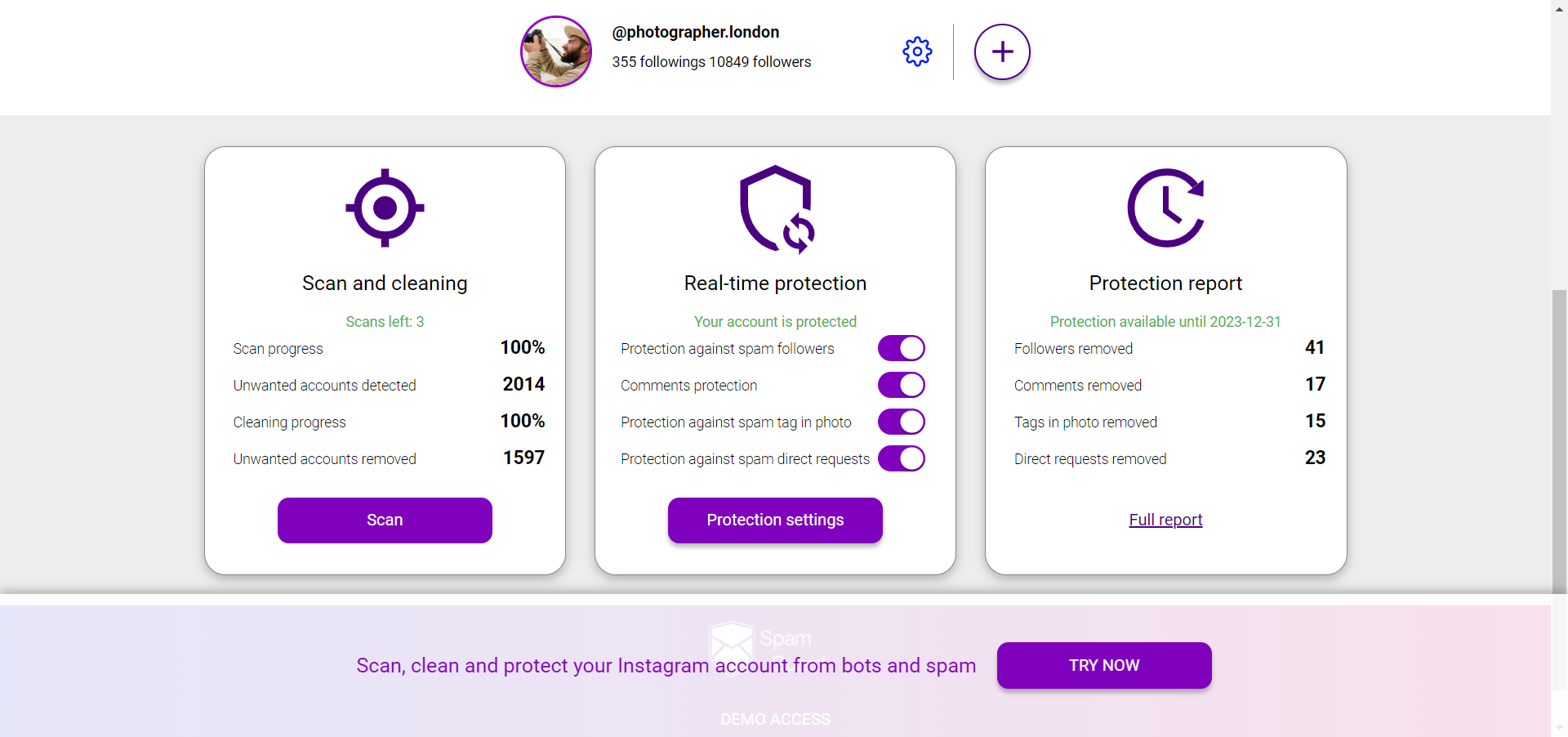
SpamGuard removes bot accounts, ghost followers, and inactive profiles through behavioral analysis, improving the quality of the initial engagement sample for both Reels and feed posts. Accounts that clean their follower base consistently see improvement in early engagement rates and, consequently, in total reach across both formats.
Analyze your follower quality for free at SpamGuard — the result shows exactly how many accounts in your follower base are suppressing your reach.
Practical Starting Points
For accounts prioritizing growth: publish three to five Reels per week and one to two carousels. Track which Reels generate new followers specifically (check follower gain in Insights after each Reel) and repeat the topic structure and format of the best performers.
For accounts prioritizing engagement with an existing audience: shift toward carousels with specific question prompts. Reels still matter, but two per week is sufficient if follower retention and depth are the primary goals.
For accounts at an engagement plateau with stagnant growth: run a follower audit before changing content strategy. If the follower base has significant inactive or bot accounts, content changes will have limited effect until the audience quality issue is resolved.
Conclusion
Reels and feed posts are not competing formats — they are complementary tools that serve different phases of the audience relationship. Reels acquire; feed posts retain and deepen. An account that uses both strategically, with a clean underlying audience, grows faster and retains that growth more durably than one that relies on a single format.
If both formats are underperforming despite consistent effort, start with a follower quality audit at spamguardapp.com. Audience quality is the foundation that determines whether any content strategy works.