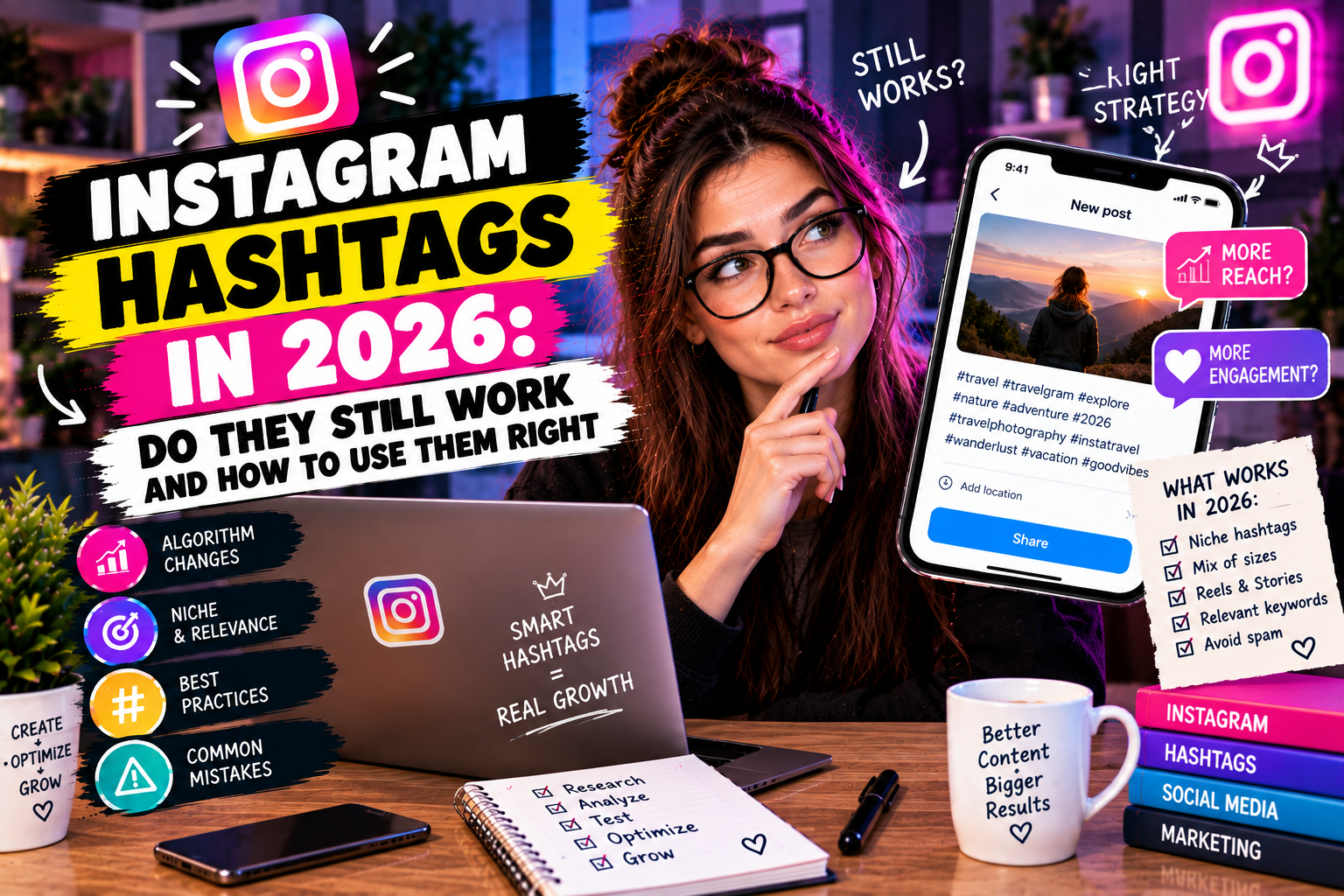
The question of whether Instagram hashtags still matter in 2026 has a complicated answer: they do, but not in the way they did in 2018. The mechanics have shifted significantly. Hashtags are no longer a primary discovery engine that reliably delivers non-follower reach to any account that uses the right tags. What they are now is more nuanced — and understanding that nuance is what separates accounts that waste time on hashtag strategy from those that use it effectively.
This guide covers how Instagram's hashtag system actually functions in 2026, what the data shows about performance impact, and which practices are worth keeping versus abandoning.
How Instagram's Hashtag System Changed
Through 2020, hashtags operated as a meaningful traffic channel: posts that ranked in hashtag feeds received sustained non-follower impressions that could add up to thousands of views per post for well-chosen tags. The system was gameable — high-volume tags, tag stacking, and keyword stuffing were common practices that sometimes worked.
The algorithm shift started in 2021 and accelerated through 2023–2024. Instagram's recommendation system became less dependent on explicit signals like hashtags and more reliant on content analysis: what the image shows, what the caption says, how the account has performed historically, and what content similar users have engaged with. Hashtags became one input among many rather than the primary discovery lever.
In 2026, Instagram itself recommends using 3–5 hashtags per post — a significant retreat from the old 30-tag practice. The platform's internal data showed that posts with fewer, more relevant tags outperformed posts with maxed-out tag stacks. This aligns with what creators and analysts have observed independently.
What Hashtags Still Do in 2026
Hashtags retain genuine utility in specific contexts:
Contextual Signals for the Algorithm
Even when hashtags don't generate direct reach through hashtag feed browsing, they function as classification signals. Instagram's content understanding system uses hashtags alongside caption text, image analysis, and account history to determine what a post is about and who might want to see it. A post about fitness photography with relevant fitness hashtags gives the algorithm clearer signals than the same post with no hashtags or generic popular ones.
This classification function is less visible than direct hashtag reach but arguably more important in the current algorithm environment.
Niche Community Discovery
Highly specific niche hashtags — those with between 5,000 and 200,000 posts — still function as browsable feeds for interested users. Someone specifically searching for #sustainablefashionuk or #sourdoughbaking is genuinely looking for content in that space. Posts that rank in these small feeds can reach genuinely interested audiences.
Broad popular hashtags (#love, #instagood, #photography) have essentially no discovery value — the feed turns over so fast that any post disappears within seconds, and no one actually browses them expecting to find relevant content.
Location Tags
Geotagging functions as a subset of the hashtag system and retains stronger discovery utility than topic hashtags, particularly for local businesses. Location-specific hashtags (#nyceats, #londonphotography) still have functional browsing audiences and more manageable competition than their broad counterparts.
What the Data Shows About Reach Impact
Multiple independent analyses of Instagram performance data in 2025–2026 show consistent patterns:
The practical implication: optimising hashtag strategy has lower ROI than it did five years ago. Time spent on content quality, posting schedule, and audience engagement produces larger reach impacts than hashtag research.
Effective Hashtag Practice in 2026
The Three-Tier Approach
The most consistently recommended approach uses three tiers of specificity:
Total: 4–6 tags. Post-specific, not a generic set applied to every post.
Research Process
For each content pillar, identify the relevant niche hashtags by searching Instagram and evaluating:
Hashtags in Caption vs First Comment
Instagram has confirmed both approaches work equivalently. Caption placement is simpler to manage; first comment placement keeps the caption cleaner visually. For most accounts, caption placement is fine. The debate over which is 'better' is not supported by meaningful performance differences.
What to Stop Doing
The Audience Quality Connection
There is an under-discussed relationship between hashtag strategy and audience quality. When an account's growth came primarily through aggressive hashtag reach in earlier years, a significant portion of those followers may be low-quality — accounts that followed based on hashtag browsing and have long since become inactive.
These inactive followers create a problem: they dilute the engagement rate, which signals to the algorithm that the account's content is less compelling than it actually is. This suppresses distribution to the active audience that does exist.
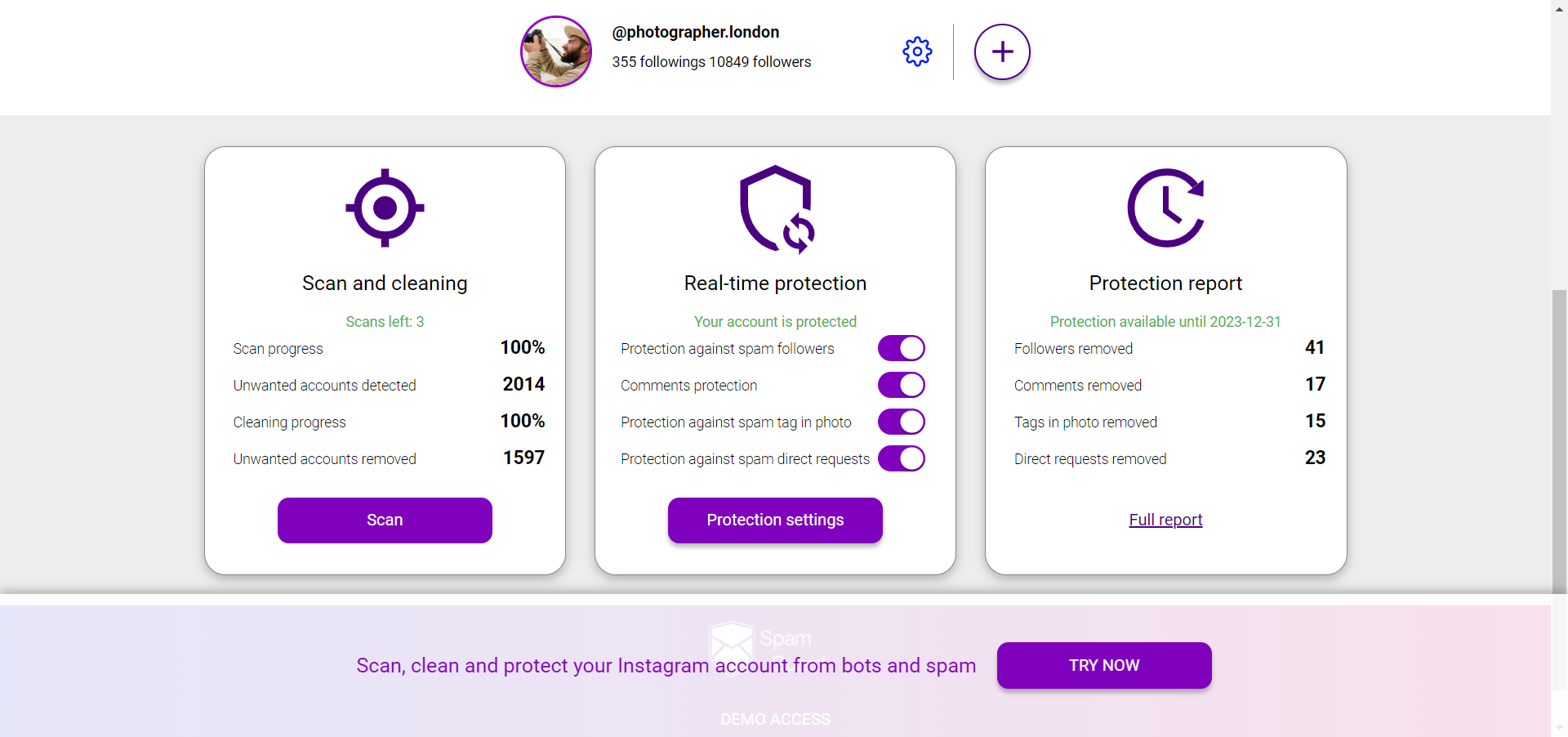
SpamGuard identifies and removes ghost followers, chronically inactive accounts, and bot accounts that have accumulated over time. After cleanup, the active follower percentage increases — which means better initial engagement tests on each new post, and more accurate algorithmic distribution.
Audit your follower quality at SpamGuard before investing in hashtag optimisation. A clean audience makes every distribution signal — including hashtag classification — work more effectively.
Hashtags on Reels vs Feed Posts
Reels operate through a different recommendation pathway than feed posts. The Reels algorithm relies more heavily on content analysis and viewer behaviour patterns, with hashtags playing a smaller explicit role. This doesn't mean ignoring hashtags on Reels, but it does mean the uplift from hashtag optimisation is smaller for Reels than for feed posts.
For Reels, the most impactful signals are watch time percentage, replays, and shares — engagement quality indicators that hashtags cannot directly affect.
Conclusion
Hashtags in 2026 are a secondary optimisation, not a primary growth strategy. They contribute to content classification and niche community discovery but no longer function as a reliable reach multiplier. The practical recommendation: use 4–6 specific, relevant tags per post, vary them by content rather than applying a fixed set, and spend the saved time on content quality and audience engagement instead.
The foundation that determines whether any distribution strategy works is audience quality. Clean up ghost followers and inactive accounts at spamguardapp.com to ensure your actual content reaches people who can respond to it.