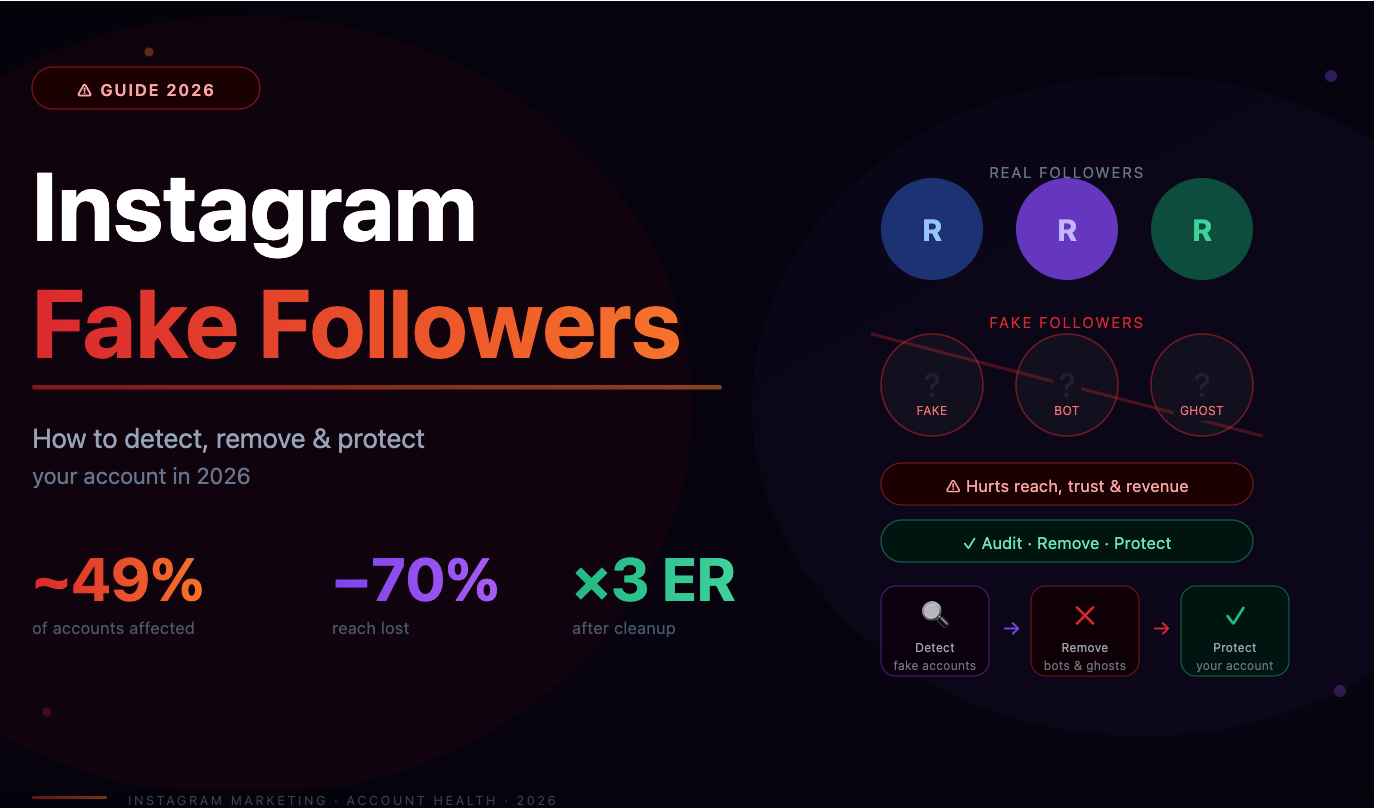
This guide covers everything: what fake followers actually are, the warning signs to look for, how to identify them at scale, and how to remove them without putting your account at risk.
What Are Fake Followers — and Are They All the Same?
The term "fake followers" covers several distinct types of accounts, each with different characteristics and different levels of impact on your metrics.
Bot accounts. Fully automated profiles with no real person behind them. They're created in bulk by software, follow thousands of accounts, and may generate automated likes or comments. The most obvious type of fake follower — often identifiable by username patterns, no profile photo, zero posts, and following-to-follower ratios in the thousands.
Zombie accounts. Once-real accounts that have been abandoned by their owners and are now inactive. They don't engage with anything, don't post, and exist only as a number in your follower count. Technically "real" in origin, functionally identical to bots in terms of engagement value.
Purchased low-quality followers. Accounts sold through follower-buying services. Some are outright bots; others are "real" accounts operated by people paid small amounts to follow specified profiles. Either way, they have no genuine interest in your content and will never engage meaningfully.
Compromised accounts. Real accounts that have been hacked and are now being operated by spam networks. These are the hardest to detect because they look legitimate — real posts, real history, real identity — but the current operator is using them to follow thousands of accounts and generate spam.
How Fake Followers Damage Your Account
Suppressed reach. Instagram's algorithm tests content by showing it to a sample of followers first. If that sample is heavy with fake accounts that don't engage, the algorithm interprets your content as low-quality and limits its distribution. Fewer real people see your posts — not because the content is bad, but because the testing sample was polluted.
Collapsed engagement rate. Your engagement rate is calculated against your total follower count. Every fake follower that never engages pulls that percentage down. An account with 10,000 followers and 3,000 fakes has an effective engagement rate calculated against a denominator that's inflated by 30%.
Brand partnership disqualification. Brands and agencies now use audience quality analysis as a standard step in influencer vetting. Accounts with a high proportion of fake followers get rejected — even if the fakes arrived organically through bot attacks, not through purchases. The cause doesn't matter to a brand checking your stats.
Potential account restrictions. Instagram actively purges fake accounts from its platform. When it does, accounts with high concentrations of fakes can experience sudden follower drops — or in some cases, receive restrictions as part of the platform's cleanup operations.
How to Spot Fake Followers: The Manual Checklist
If you want to audit a sample of your followers manually, here are the signals that indicate a fake account:
No profile photo or a clearly AI-generated or stock image
Username that looks auto-generated: random strings of letters and numbers, or a real name followed by a long string of digits (e.g., john.smith.8847362)
Zero or very few posts, often with no content at all
Following thousands of accounts while having very few followers themselves — a classic bot signal
Account created recently with no history of activity
Bio that's empty or contains only a link to an external site
Comments that are generic: "Great post!", "Amazing!", single emojis — consistent across multiple posts and accounts
No single signal is conclusive — a real person might have no profile photo or few posts. But when three or more of these indicators appear on the same account, the probability of it being fake is high.
How to Check Your Overall Fake Follower Ratio
Spotting individual fakes is useful for understanding the problem, but what you really need is the proportion: what percentage of your total follower base is fake or low-quality?
A rough manual estimate: look at your last 10 posts and calculate your average engagement rate (total likes + comments divided by total followers, multiplied by 100). Industry benchmarks by follower size:
Under 10K followers: healthy ER is 5–10%
10K–100K followers: healthy ER is 2–5%
100K–500K followers: healthy ER is 1–3%
500K+ followers: healthy ER is 0.5–2%
If your engagement rate is significantly below these benchmarks, a high fake follower proportion is the most likely explanation.
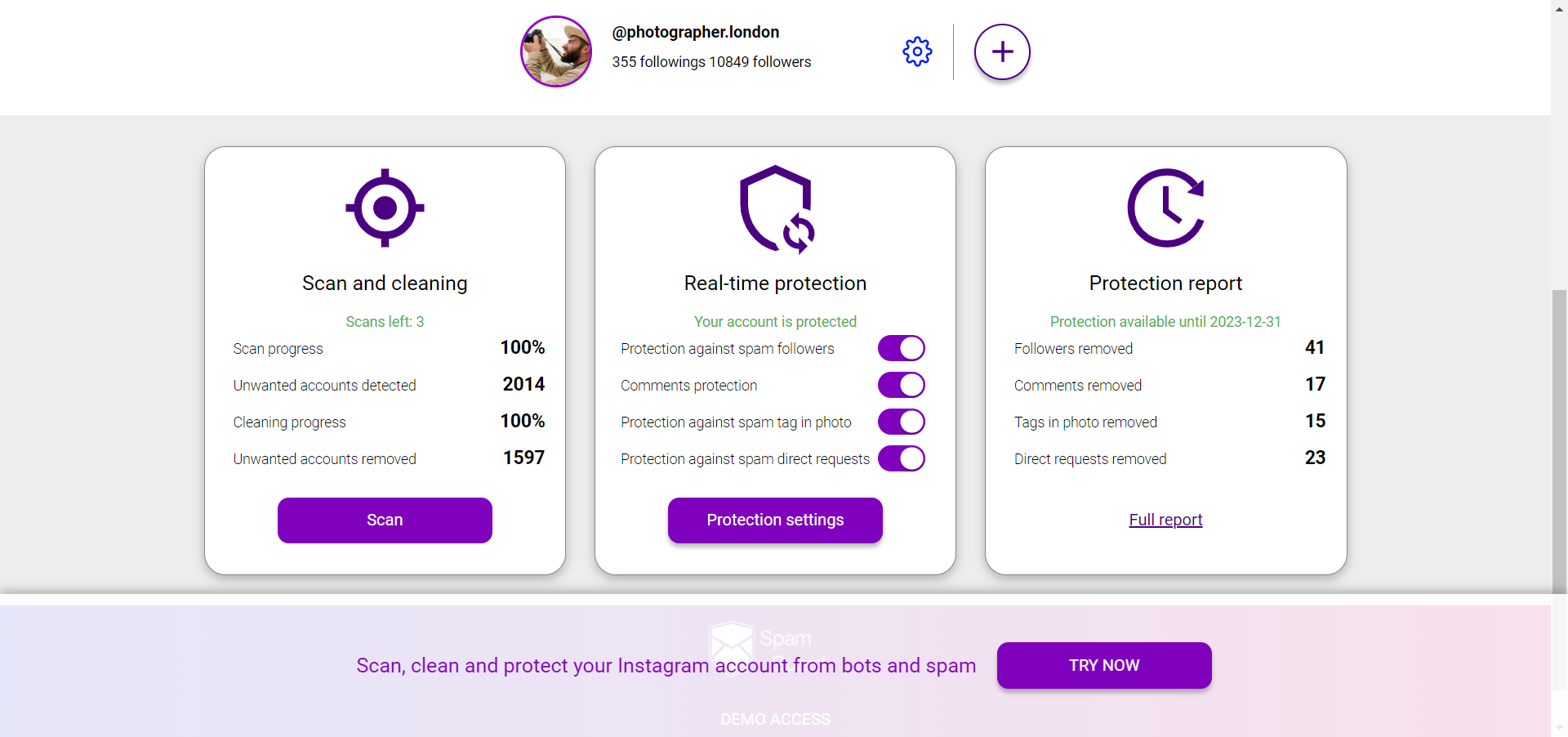
For a precise audit, use SpamGuard. It scans your entire follower list against dozens of detection criteria and produces a detailed breakdown: what percentage are bots, what percentage are inactive, what percentage are commercial or spam accounts. You get a clear picture of exactly what's in your audience — not an estimate.
How to Remove Fake Followers
Instagram added a native follower removal feature several years ago. You can go to your follower list, tap any account, and select Remove — the account is removed from your followers without notification. This is the safest method, but it's manually intensive.
For accounts with significant fake follower problems — hundreds or thousands of low-quality accounts — manual removal is impractical. The realistic solution is an automated tool that:
Identifies fake and low-quality accounts accurately, not just based on one or two signals
Removes them gradually, within Instagram's rate limits, to avoid triggering account restrictions
Lets you set criteria (e.g., only remove accounts with no posts and no profile photo) so you control what gets removed
Offers whitelisting to protect specific accounts from removal regardless of how they score
SpamGuard is built specifically for this use case. Connect your account, run the audit, set your removal criteria, and let the tool process the cleanup gradually in the background. You get regular email reports showing progress — how many accounts have been removed, how your audience quality metrics have changed.
What About Fake Followers That Arrive Organically?
Many account owners are surprised to discover significant fake follower accumulation even though they've never purchased followers. This is normal — bots follow accounts automatically as part of their operation, regardless of whether you invite them.
Common sources of unsolicited fake followers:
Viral content. When a post gets significant reach, it attracts follows from bots that are programmed to follow any account generating activity.
Hashtags. Posting with popular hashtags exposes your content to bot networks that follow accounts using those tags.
Competitor attacks. In some niches, bad actors use bots to inflate competitors' fake follower ratios, damaging their engagement metrics and brand partnership eligibility.
General bot activity. Many bots simply follow accounts indiscriminately as part of their mass-follow operations.
This is why ongoing protection matters as much as one-time cleanup. SpamGuard can monitor your follower list in real time and automatically remove new fake accounts as they arrive — so your audience stays clean without requiring recurring manual effort.
After the Cleanup: What to Expect
Your follower count will drop. If you've accumulated thousands of fake followers over time, the drop can be significant. This is the intended result — not a side effect to worry about.
Within a few weeks of cleanup, most accounts see measurable improvements in reach and engagement rate. The algorithm's content distribution improves because the engagement signals it receives — from a now-smaller but more real audience — are stronger and more consistent. Posts that previously reached 8% of followers may start reaching 12–15%.
The underlying account becomes more valuable even as the follower count decreases: more accurate analytics, better algorithm treatment, stronger brand partnership prospects, and a feed that genuinely reflects your real audience's behavior.