What Is Instagram Engagement Rate?
Engagement rate measures the percentage of your audience that actively interacts with your content. The standard calculation:
ER = (Likes + Comments + Saves + Shares) / Followers × 100%
Some calculations include only likes and comments; more comprehensive versions include saves and shares. The broader definition is more useful because saves and shares are the strongest engagement signals in Instagram's current algorithm — weighted more heavily than passive likes.
You can also calculate engagement rate by reach rather than followers:
ER by Reach = (Likes + Comments + Saves + Shares) / Reach × 100%
This version tells you how engaging your content is for people who actually saw it — which can reveal algorithm distribution issues that the follower-based calculation hides.
2026 Engagement Rate Benchmarks by Account Size
Account Size | Good ER | Strong ER |
Under 1,000 followers | 8–15% | 15%+ |
1K–10K (Nano) | 5–10% | 10%+ |
10K–100K (Micro) | 2–5% | 5%+ |
100K–500K (Mid-tier) | 1–3% | 3%+ |
500K–1M (Macro) | 0.5–2% | 2%+ |
1M+ (Mega) | 0.3–1% | 1%+ |
These benchmarks reflect organic engagement on regular posts. Reels and carousels often perform above these baselines; static single images tend to fall below. If your engagement rate is significantly below the benchmark for your tier, it's a signal worth investigating.
Why Engagement Rate Declines — and the Most Common Cause
Engagement rate naturally decreases as accounts grow — a post reaching 3% of 500,000 followers represents far more real interactions than a post reaching 8% of 5,000 followers. This is normal.
What's not normal: engagement rate declining significantly while follower count stays flat or grows. This pattern almost always points to audience quality problems.
Fake and bot followers. Every fake follower in your audience is a denominator with zero numerator. They follow, they never engage, they drag your ER down permanently. An account with 20,000 followers where 6,000 are bots is effectively calculating engagement against 20,000 while only 14,000 can ever actually engage.
Ghost followers. Real people who once followed you but never engage — either because they lost interest or because they're simply inactive on the platform. The effect on your metrics is identical to bots.
Giveaway-driven growth. Running giveaways that attract prize-seekers rather than genuine interest followers inflates your count with people who will never engage with your regular content.
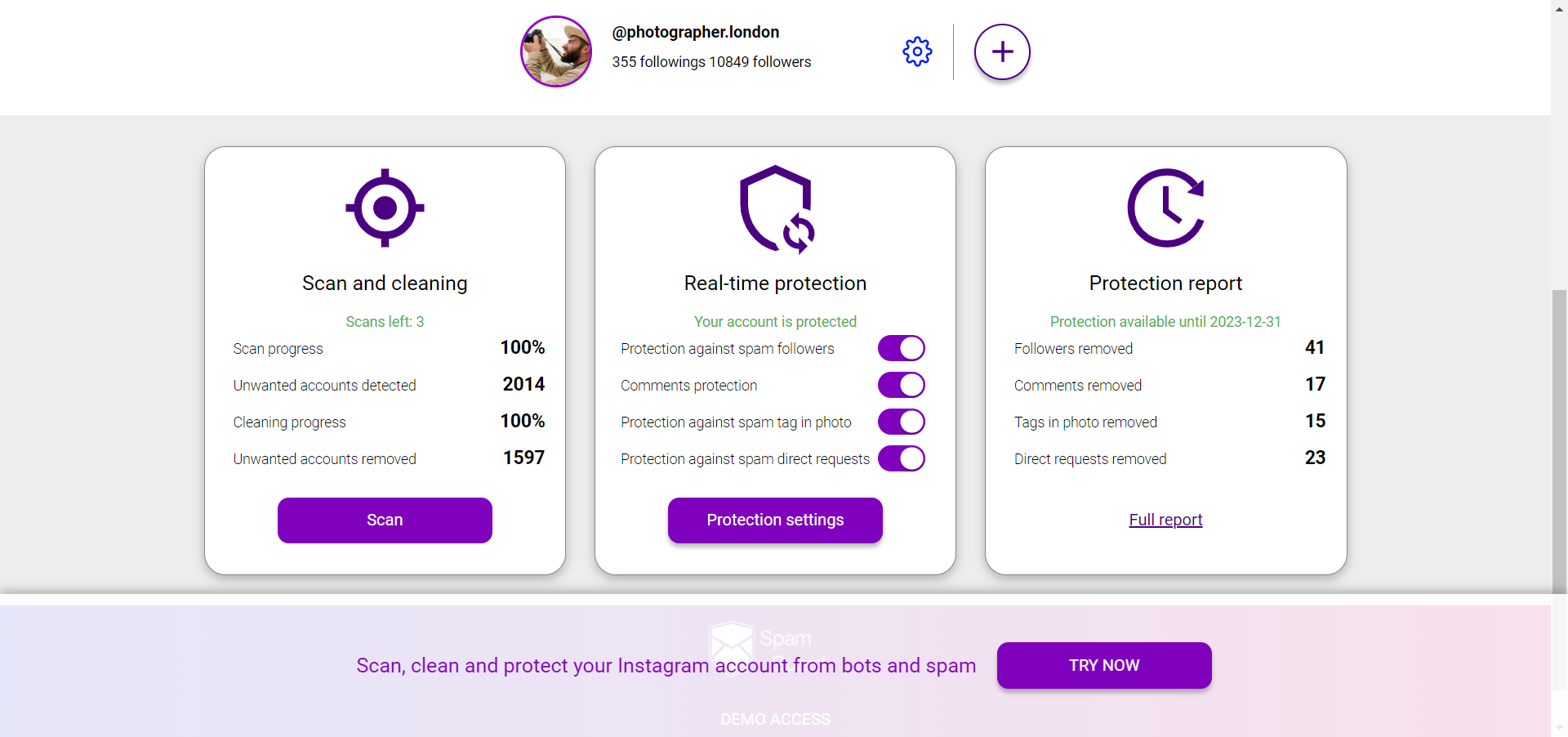
Diagnosing the problem starts with an audience audit. SpamGuard analyzes your follower base and categorizes accounts by quality — identifying the bots, inactive profiles, and low-value accounts that are artificially suppressing your engagement rate. Once you know the scale of the problem, you can clean it up.
How to Calculate Your Current Engagement Rate
If you want to calculate Instagram engagement rate quickly and accurately, try our dedicated calculator tool. It helps you evaluate account performance, benchmark your results against industry averages, and track the impact of changes to your content strategy over time.
Step 1: Go to Instagram Insights (for professional accounts) or calculate manually.
Step 2: Look at your last 10–15 posts. For each post, add up likes + comments + saves + shares.
Step 3: Divide by your follower count and multiply by 100. Average across your selected posts.
A single post's ER can vary widely based on topic, format, and timing. Averaging across 10–15 posts gives you a reliable baseline that smooths out individual outliers.
Compare your result to the benchmarks above. If you're at or above the "Good ER" threshold for your account size, your audience quality is probably healthy. If you're significantly below — especially if you haven't been purchasing followers — fake and inactive accounts are the most likely culprit.
Practical Ways to Improve Your Engagement Rate
1. Clean your audience first. This is the highest-leverage action for most accounts with engagement rate problems. Removing fake and inactive followers improves your ER mathematically — the same interactions are now measured against a smaller, more accurate denominator. Use SpamGuard to identify and remove low-quality accounts safely and gradually.
2. Focus on saves and shares. In 2026, these are the engagement signals Instagram weights most heavily. Create content specifically designed to be saved: step-by-step guides, frameworks, reference lists, before-and-after examples. Ask yourself before posting: would I save this?
3. Use Carousels and Reels strategically. Carousels generate above-average engagement because the swipe action keeps viewers on your post longer — a positive signal. Reels get prioritized in recommendations, reaching non-followers who can become engaged new ones.
4. Write captions that invite responses. A direct question at the end of a caption consistently increases comment rates. The question should be easy to answer and genuinely interesting — not "What do you think?" but "Which of these approaches has worked for you?"
5. Reply to every comment in the first hour. Comment velocity in the early window after posting is a significant algorithm signal. Replying to comments extends the conversation, increases comment count, and signals to Instagram that your post is generating genuine engagement worth distributing.
6. Post at peak times for your specific audience. Check your Insights for when your followers are most active. Peak posting times vary significantly by niche and audience demographics — don't rely on generic "best time to post" lists.
7. Audit and refresh your content mix. Look at which of your last 30 posts had the highest saves and shares — not just likes. Identify the patterns: topic, format, length, style. Do more of what those posts did.
Engagement Rate and Brand Partnerships
For creators pursuing brand partnerships, engagement rate is often the deciding metric. Brands have shifted away from follower count as a primary criterion — too many accounts with inflated numbers and low real reach. They now typically require a minimum ER threshold as part of their influencer criteria.
Common brand requirements in 2026: 2%+ ER for micro-influencers (10K–100K), 1%+ for larger accounts. Accounts below these thresholds are often passed over regardless of follower count.
The practical implication: a clean audience with strong engagement makes you more valuable to brands than a large audience with weak engagement. An account with 15,000 followers and 5% ER will typically command better partnership terms than an account with 50,000 followers and 0.8% ER.
Building that strong engagement rate starts with the foundation: a real, active audience. Removing the fake followers and inactive accounts that suppress your ER is the first step — and SpamGuard is the practical tool for doing it at scale, safely, without risking your account.