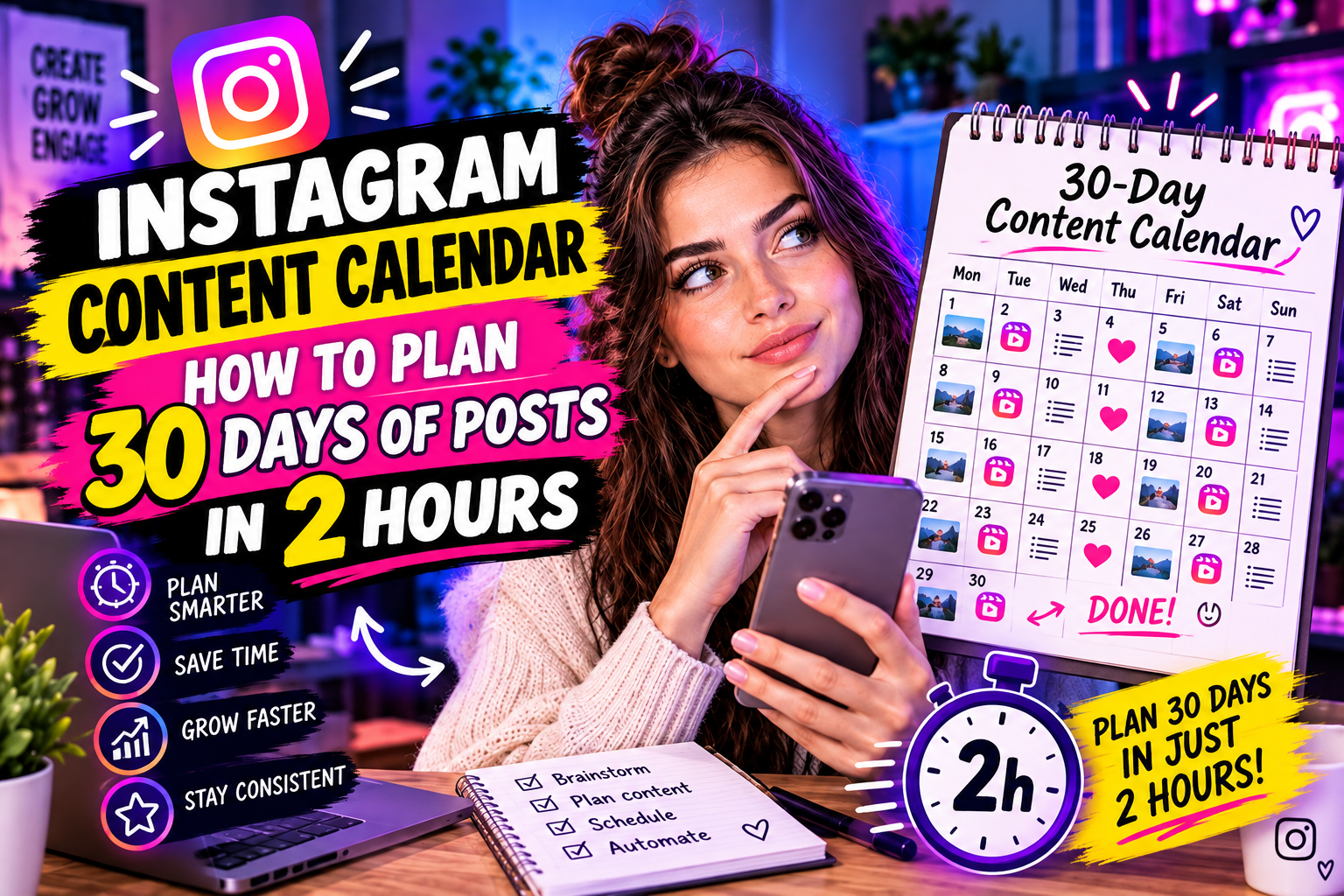
Most Instagram content planning fails not because people run out of ideas, but because the planning process itself is too heavy. If building the content calendar takes as long as creating the content, it's not saving you anything. This is a system for planning a full month of Instagram content in a single two-hour session, with enough structure that the plan actually holds through the month.
Why Monthly Planning Beats Weekly Planning
Planning week by week keeps you reactive. You're constantly in content creation mode with no breathing room for the larger picture. Monthly planning creates breathing room: you see patterns, you can align content with upcoming events or launches, and you batch your creative work instead of fragmenting it across four separate planning sessions.
The objection: 'things change, monthly plans become outdated.' This is true for the details, not the structure. A monthly plan doesn't need to specify every caption — it needs to specify the topic and format for each post. Captions can adapt. The structure keeps you from scrambling.
The 2-Hour Framework: What You're Actually Doing
Minutes 0-20: Content audit and theme setting.
Before planning forward, look back. What performed well last month? Open Instagram Insights and note your top 5 posts by reach and your top 5 by saves. These are your two most important engagement signals: reach shows what Instagram amplified, saves show what your audience found worth returning to.
From this, identify 2-3 content themes that your audience responds to. These become the pillars of your monthly plan. Example pillars for a marketing account: 'tactical how-tos', 'industry commentary', 'behind the scenes process'.
Minutes 20-40: Map your month.
Take a blank calendar grid for the month. Mark:
• Your target posting frequency (3x/week = 12-13 posts, 5x/week = 20-22 posts)
• Any upcoming events, launches, or external dates worth aligning with
• Any days you know you won't be able to post
Distribute your pillar themes across the remaining slots. A simple rotation — Pillar A, Pillar B, Pillar C, repeat — gives you automatic variety without having to decide each time.
Minutes 40-80: Fill the slots.
Now, working quickly, assign a specific topic to each slot. Not a caption — a topic. 'How to structure a week of content in 20 minutes' is a topic. 'Caption TBD' is not useful. Use the following format for each slot:
• Topic: the specific angle or question the post answers
• Format: single image, carousel, Reel, or Story series
• Hook idea: just the opening concept, one sentence
40 minutes for 12-20 slots is about 2-3 minutes per post. Keep moving — depth comes at creation time.
Minutes 80-100: Story layer.
Stories are separate from feed posts in cadence and function. For each week, plan 3-5 Story touchpoints: at least one interactive (poll or question), one that extends or teases a feed post, one personal or behind-the-scenes. These don't need to be as detailed — just note the type and trigger ('poll about topic from Monday's post', 'behind the scenes of Wednesday shoot').
Minutes 100-120: Review and buffer.
Read through the whole plan. Look for: gaps longer than 4 days, too many consecutive posts in the same format, any weeks that look light. Adjust. Use the remaining time to create one or two posts in advance — if you end the session with two posts actually created, you've built in a buffer for the first week.
How to Generate Topics Quickly
The hardest part of content planning for most people is coming up with enough topics. A few reliable methods:
Mine your DMs and comments.
What do people ask you repeatedly? Every repeated question is a post topic. If three people this month asked you 'how do you decide what to post when you're out of ideas' — that's a post topic. It's already pre-validated by real audience curiosity.
Opposite posts.
Take your most popular post and write its opposite: if you wrote 'why X works', write 'when X doesn't work'. Counterintuitive angles consistently outperform conventional wisdom posts.
Your own expertise broken down.
Write down the 5-7 things you know that most people in your audience don't. Each one is a post. Each sub-point within each one is another post. A single insight can generate 3-5 pieces of content when broken down into components, applied to specific scenarios, and shown with examples.
Maintaining the Plan Through the Month
A content calendar only works if you actually use it. Two habits that make it stick:
• Weekly 15-minute review: every Sunday, check what's coming up that week. If anything needs adjusting (a topic that became irrelevant, an opportunity that emerged), do it now — not at posting time.
• Creation batch: create content 3-5 days before it's scheduled, not the day of. This eliminates the panic of empty-slot days and lets you sleep on drafts before publishing.
When you miss a post — and you will occasionally — don't skip the next day to compensate or double-post. Just continue with the plan. Consistency over time matters more than any individual post.
For tracking whether the content you're publishing reaches real, engaged people rather than bot accounts — SpamGuard for audience quality monitoring. For reaching new targeted audience with your planned content — Zengram.