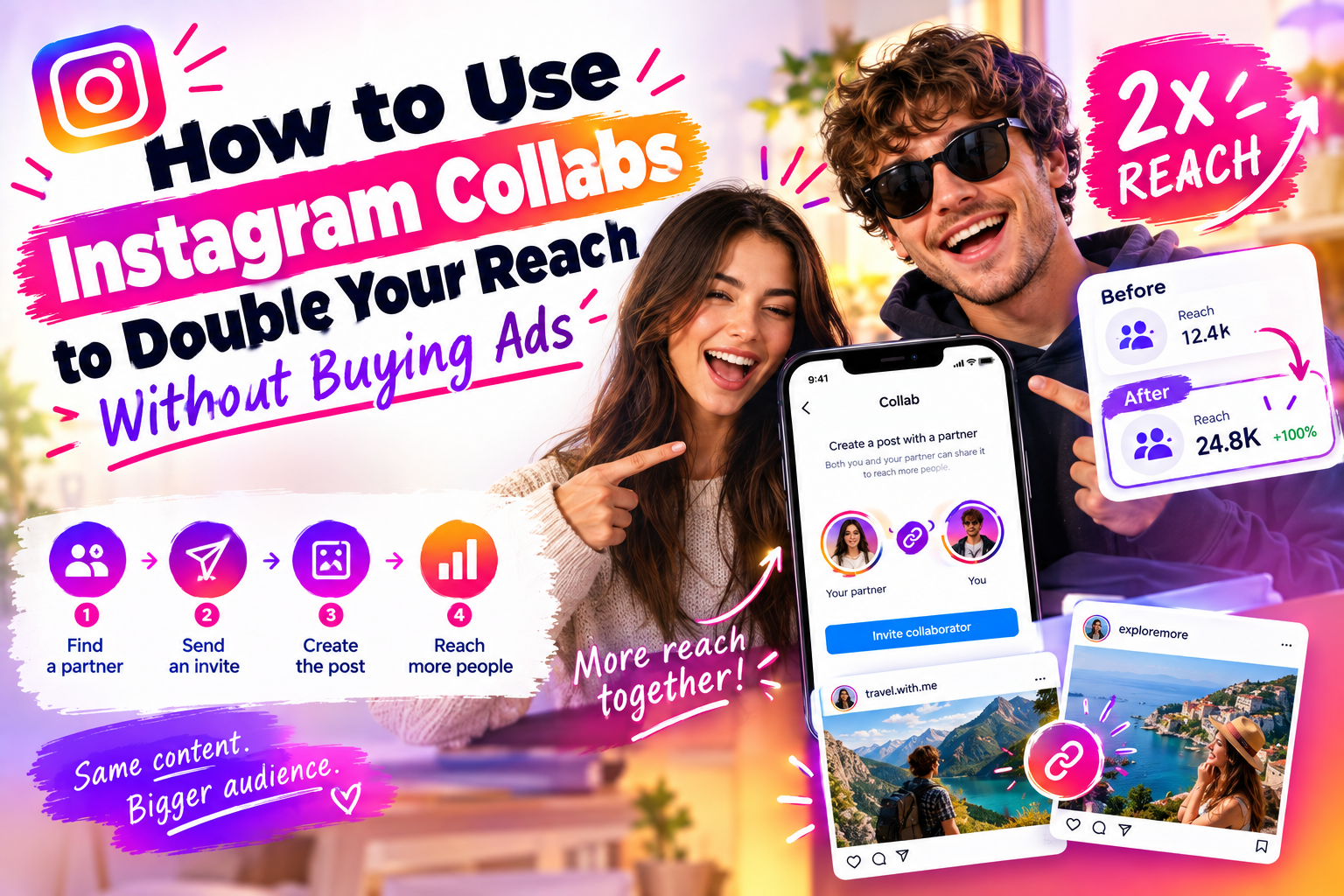
Instagram's Collab feature — introduced in 2021 and significantly expanded since — allows two accounts to co-author a single post or Reel that appears simultaneously on both profiles. Both accounts receive credit, both appear in the post header, and all engagement accumulates on one shared piece of content. For accounts looking to grow without advertising spend, Collabs represent one of the most structurally underused tools available in 2026.
This guide covers the complete picture: how Collabs work mechanically, why they outperform traditional cross-promotion formats, how to find and pitch the right partners, what types of content work best, and how audience quality affects the real reach delivered by any collaboration.
The Mechanics of a Collab Post
A Collab is initiated during the post creation flow. After composing the caption and selecting the content, the primary author taps 'Tag People' → 'Invite Collaborator' and selects the partner account. The partner receives an in-app notification and can accept or decline. If accepted, the post appears on both profiles with both usernames displayed in the post header.
Critical mechanics to understand:
Why Collabs Outperform Traditional Cross-Promotion
Before the Collab feature existed, cross-promotion meant shoutouts: Account A posts mentioning Account B, Account B does the same. Each post lives separately, engagement is split, and followers must actively navigate to the other account. The conversion rate from shoutout to follow is relatively low.
Collabs solve each of these problems:
Finding the Right Collab Partner
The quality of a Collab is almost entirely determined by partner selection. A poorly matched partner delivers little value even with excellent content. Three criteria define a strong Collab partner:
Criterion 1: Overlapping but Non-Competing Audience
The ideal partner serves the same type of person from a complementary angle. Their audience and yours should have high overlap in interests, demographics, and purchasing behaviour — but neither account should be a direct substitute for the other. Examples:
The test: would following both accounts make sense for the same person? If yes, the audiences overlap appropriately.
Criterion 2: Comparable Engagement Quality
Follower count is a misleading metric for Collab partner evaluation. What matters is how many of the partner's followers are genuinely active and likely to engage with the shared content. An account with 6,000 highly engaged followers in the right niche will deliver more useful cross-audience exposure than an account with 40,000 followers and 0.8% engagement.
Before reaching out, review the partner's last 12 posts:
Criterion 3: Compatible Content Style
A Collab post appears on both profiles. If the visual aesthetic, production quality, or tone is significantly mismatched between the two accounts, the post feels out of place on one of them — which reduces engagement from that account's audience. Look for partners whose content could plausibly appear on your profile and vice versa, even if the specific topics differ.
How to Pitch a Collab: Structure That Gets Responses
Most Collab pitches fail because they are vague, self-serving, or both. A pitch that works is specific, concise, and explicitly framed around mutual value. The structure:
Send via DM rather than email where possible. DMs on Instagram have a higher open rate for creator-to-creator communication and feel more natural for the platform context.
Content Formats That Perform Best as Collabs
Not all content types translate equally well to Collabs. The formats that consistently deliver strong results:
The Audience Quality Dimension
Collabs multiply reach across both accounts' follower bases — but the multiplication only works if those follower bases contain genuinely active accounts. Ghost followers, bot accounts, and chronically inactive profiles are counted in the follower totals but contribute nothing to the Collab's initial engagement signal.
This has a concrete effect: if your account has 10,000 followers but 3,000 are ghost followers, you effectively contribute the engagement signal of a 7,000-follower active account to the Collab's first-hour evaluation. A partner evaluating your account by follower count alone would expect more reach delivered than the real audience quality supports.
The same issue affects how the Collab distributes on your side: when the algorithm shows the Collab to a sample of your followers, a high ghost follower ratio means the sample underperforms, which limits the algorithm's confidence in the content and restricts broader distribution.
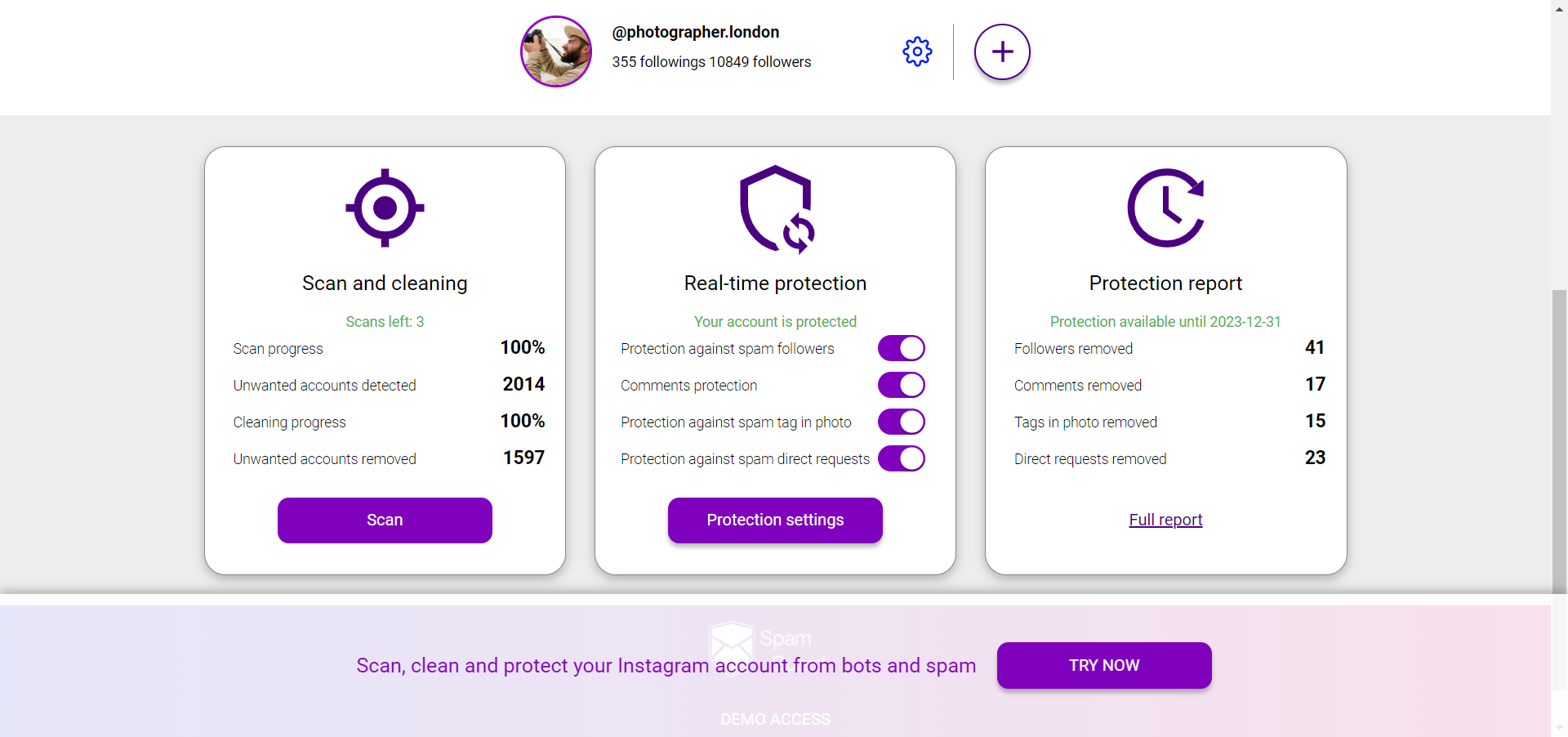
SpamGuard identifies ghost followers, bot accounts, and inactive profiles through behavioural analysis and removes them safely. After cleanup, your account's real follower quality improves — which means your side of any Collab delivers the reach that partner accounts expect when they see your follower count.
Audit your follower quality before pursuing Collab partnerships at SpamGuard. A clean audience makes your account a more valuable Collab partner and ensures both sides of any collaboration deliver genuine reach.
Tracking Collab Results
After a Collab posts, monitor these metrics over the first 48 hours:
This data tells you whether the partner's audience was genuinely relevant. A Collab that brought significant profile visits but few new followers suggests the content format was the issue. A Collab that brought few profile visits from the partner's side suggests audience relevance was weaker than expected.
Conclusion
Instagram Collabs are structurally superior to traditional cross-promotion for accounts prioritising organic growth. They unify engagement, appear natively in both feeds, carry implicit mutual endorsement, and draw from both audiences simultaneously during the algorithm's critical evaluation window.
The foundation for effective Collabs is a clean, genuinely engaged follower base. The reach you deliver to your Collab partner — and the quality of the engagement signal that determines how broadly the Collab distributes — depends directly on how much of your follower count represents real, active people.
Check your follower quality at spamguardapp.com before pursuing Collab partnerships. The audit is free and takes a few minutes.