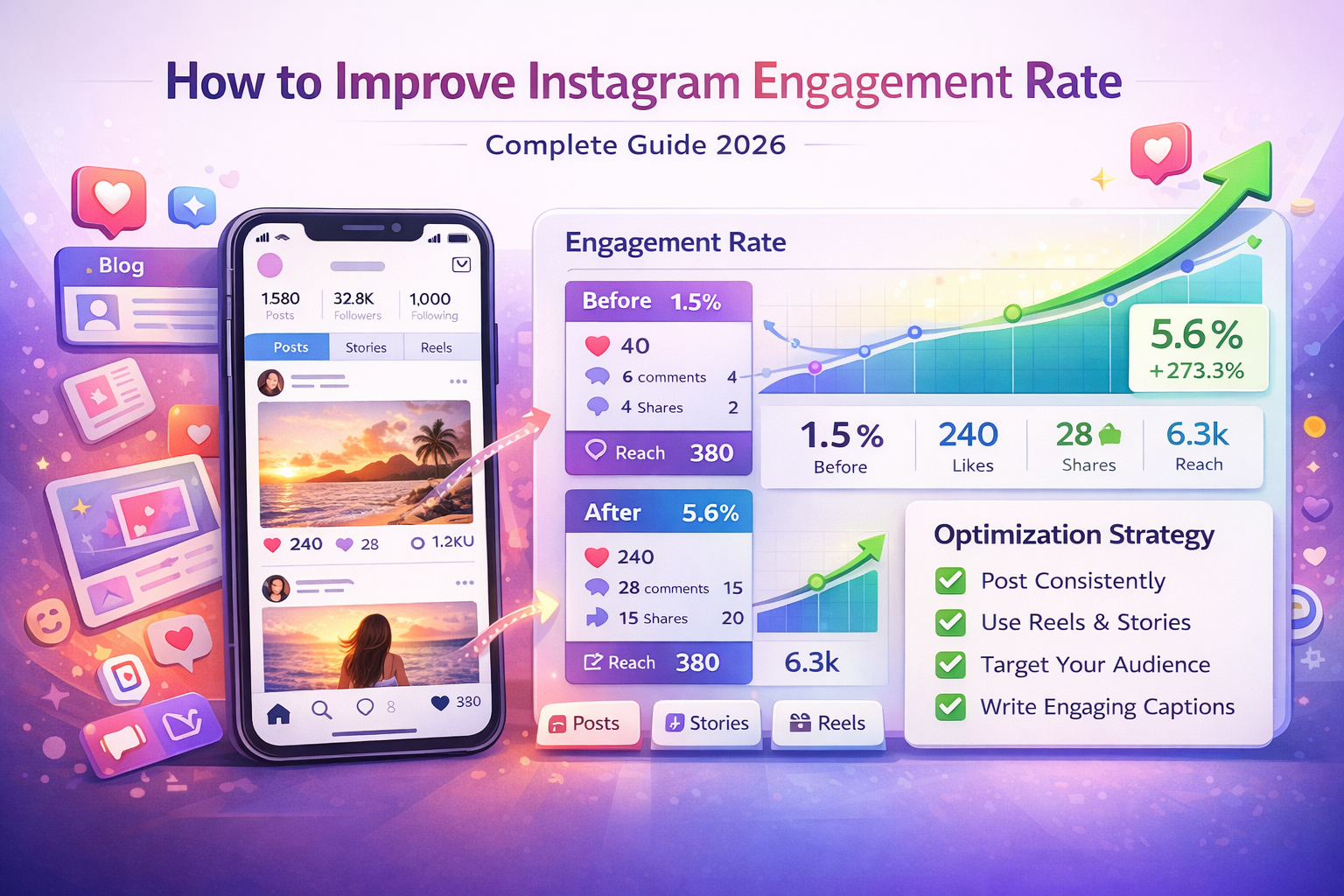
In this guide, we'll break down what engagement rate actually means, why it matters, what's killing yours — and how to fix it systematically.
To understand how well your content is performing, use our Instagram engagement rate calculator to get a quick overview of your current metrics. It helps you measure engagement more accurately, spot weak points in your content strategy, and focus on the changes that can improve results in 2026.
What Is Instagram Engagement Rate and Why Does It Matter?
Engagement rate (ER) is the percentage of your followers who actively interact with your content — through likes, comments, saves, shares, and story replies. It's calculated as:
ER = (Total Interactions / Followers) × 100%
A healthy engagement rate on Instagram in 2026 sits around 1–5% depending on account size. Nano-influencers (under 10K) typically see 5–10%. Large accounts over 500K often average below 1% — but even then, the ratio matters enormously.
Why does it matter so much?
- The Instagram algorithm uses engagement signals to decide how widely to distribute your posts. Low ER = limited reach.
- Brands and advertisers scrutinize ER when evaluating influencer partnerships. A fake-looking ER kills deal potential.
- High engagement signals a loyal, interested audience — the kind that actually converts into customers or fans.
What's Killing Your Engagement Rate?
Before you can fix your ER, you need to understand what's breaking it. Here are the most common culprits.
Bots and fake followers. When you accumulate fake accounts — whether through past purchases, mass-follow schemes, or bot attacks from competitors — they dilute your ER. A bot never watches your Reel, never taps your story, never saves your post. But it still counts in your denominator.
Inactive and ghost accounts. Real people who once followed you but haven't opened Instagram in months (or years) contribute zero engagement. These "dead" followers are particularly damaging because they're harder to detect than obvious bots.
Irrelevant commercial accounts. Mass-follow tools and follow-for-follow schemes often attract promotional accounts and spam profiles. They follow to be seen, not to engage.
Audience-content mismatch. If your follower base grew during a different content era — or through giveaways attracting prize-seekers — many of them may simply not be interested in what you currently post.
How to Audit Your Instagram Audience
Step one is knowing what you're dealing with. Here's how to conduct a proper audience audit:
Manual spot check. Browse through your followers list and look for red flags: no profile photo, username full of random numbers, zero posts, following thousands of accounts. This gives you a feel for the problem but doesn't scale.
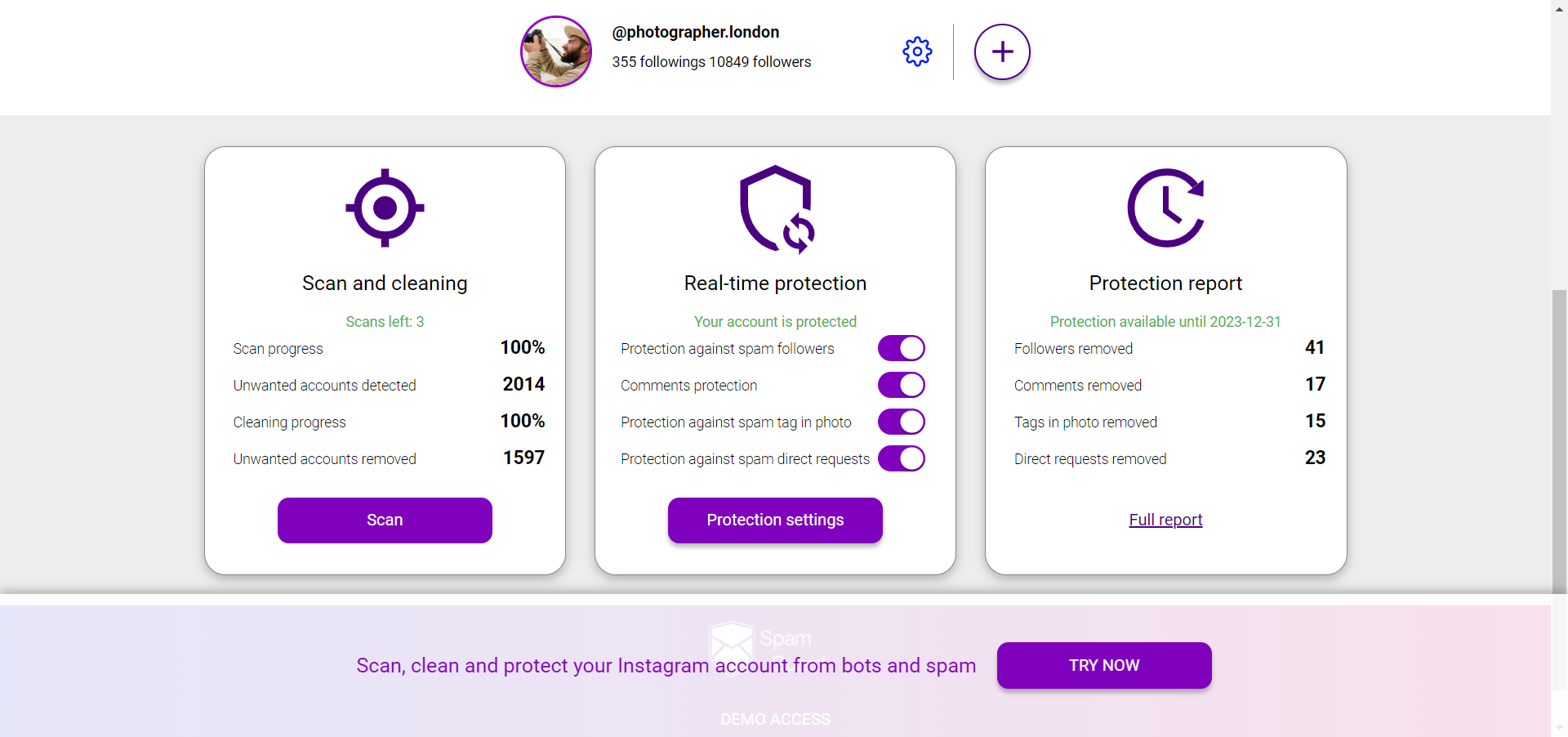
Use an automated analysis tool. For any account over a few hundred followers, manual review is impractical. This is where a dedicated service like SpamGuard becomes essential. It scans your entire follower base against dozens of criteria and produces a detailed breakdown: bots, inactive accounts, commercial profiles, foreign accounts, and more.
After your audit, you'll have a clear picture: what percentage of your audience is genuinely engaged, and how much dead weight is pulling your ER down.
Cleaning Your Audience: Step by Step
Once you know the scale of the problem, it's time to act. Here's a practical cleaning process:
1. Start with the most obvious offenders. Bots and clearly fake accounts should be removed first. They provide zero value and are most likely to trigger algorithm penalties.
2. Remove inactive accounts gradually. Don't purge thousands of followers overnight. Instagram's algorithm can flag sudden large drops as suspicious. Use a service that respects platform rate limits and removes followers incrementally.
3. Set up ongoing protection. Cleaning is not a one-time event. New bots will appear — especially if you're growing. SpamGuard offers real-time monitoring: it detects new fake followers as they arrive and removes them automatically, so your audience stays clean without recurring manual effort.
4. Use whitelists and blacklists. Protect important accounts (business partners, clients, collaborators) from accidental removal using a whitelist. Add known spam accounts to a blacklist for forced removal.
What Happens After You Clean Your Audience?
The results are predictable and well-documented. As the ratio of real, active followers increases, the algorithm registers higher engagement as a percentage of total followers — and starts distributing your content more broadly.
Users who've cleaned their Instagram audience with SpamGuard report:
- 20–40% improvement in post reach within the first few weeks
- Higher story views and completion rates
- Better response rates to calls-to-action
- Increased follower growth from organic recommendations
The underlying logic is simple: a smaller, real audience outperforms a large fake one in every meaningful metric.
Common Mistakes to Avoid
Don't buy followers — ever. The short-term vanity boost isn't worth the long-term engagement damage. Purchased followers are mostly bots or low-quality accounts, and they'll need to be cleaned out later anyway.
Don't over-rely on giveaways. Giveaways drive follower spikes, but prize-seekers are among the least engaged audience segments. If you run giveaways, do it with clear targeting and follow up with content that filters for genuine interest.
Don't remove followers too aggressively. Dropping 10,000 followers in 24 hours looks unnatural to Instagram. Use tools that pace removal within safe limits.
Don't ignore the content side. Cleaning your audience improves the conditions for engagement, but your content still needs to be worth engaging with. Combine audience hygiene with a strong content strategy.
The Long-Term Approach: Audience Hygiene as a Habit
The most successful Instagram accounts in 2026 treat audience quality as an ongoing concern, not a one-off project. Schedule quarterly audits. Monitor engagement trends. Set up automated protection so new bots are blocked before they accumulate.
Tools like SpamGuard make this easy: connect your account once, and the service handles ongoing monitoring and removal in the background. You focus on creating content; SpamGuard keeps your audience clean.
A clean audience isn't a luxury — it's the foundation that makes everything else work. Better reach, better partnerships, better conversions. The work starts with knowing who's actually following you.