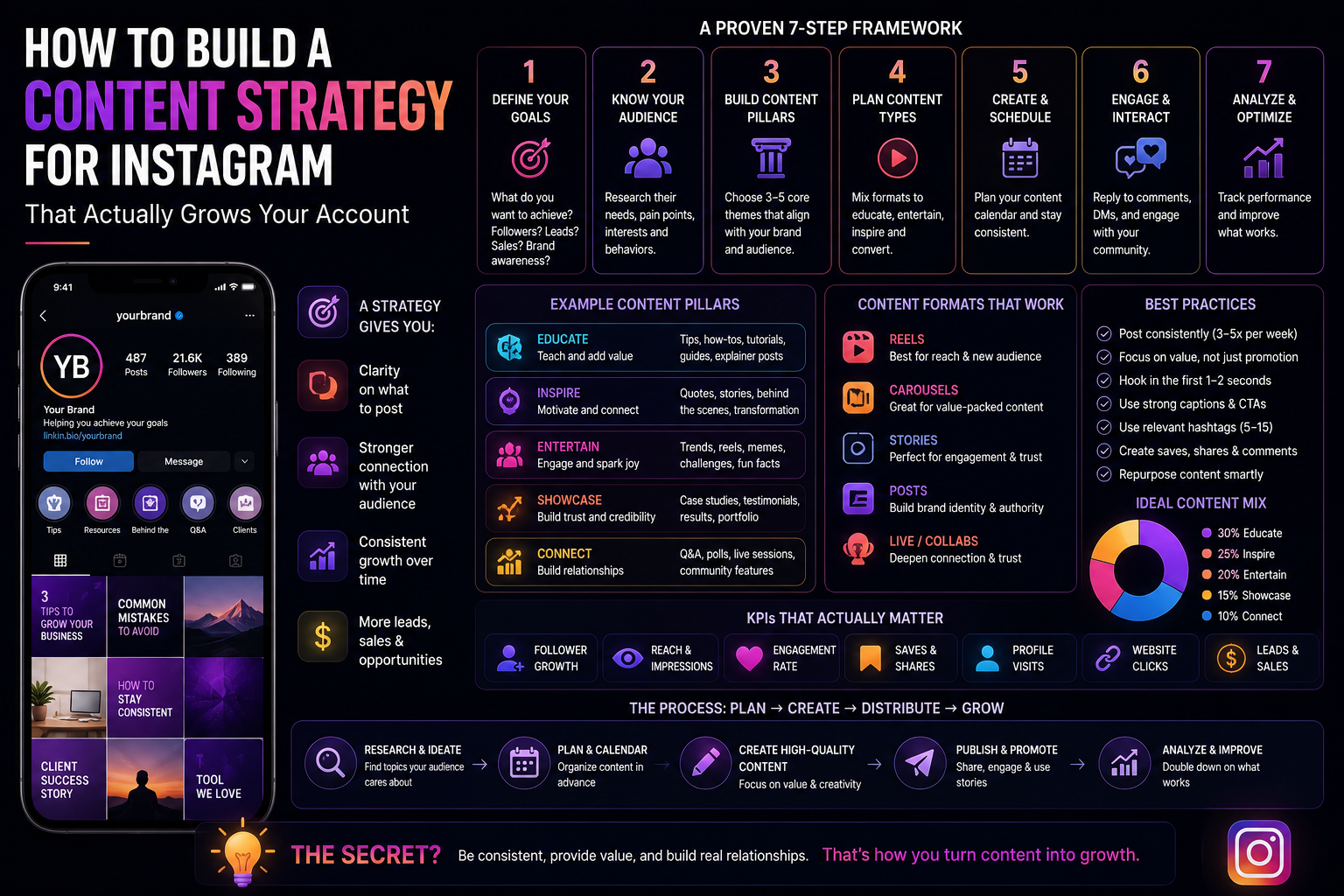
Most Instagram accounts do not have a content strategy — they have a posting habit. There is a significant difference. A posting habit is showing up regularly with whatever content feels right at the time. A strategy is a system that connects each piece of content to a defined goal, measures whether it is working, and adjusts based on data.
The accounts that grow consistently are almost always strategy-driven, not inspiration-driven. This guide covers how to build a content strategy from scratch — defining goals, identifying content pillars, choosing formats, building a calendar, and measuring what matters.
Step 1: Define One Primary Goal
Content strategy fails when it tries to accomplish everything simultaneously. Growth, engagement, sales, community, authority — these require different content approaches, different formats, and different success metrics. Trying to optimize for all of them at once optimizes for none.
Choose one primary goal for the next 90 days:
Secondary goals can exist alongside the primary one, but every content decision should first serve the primary goal.
Step 2: Define Your Content Pillars
Content pillars are the three to five topic categories that every piece of content falls into. They define what the account is about and ensure variety without randomness.
A well-structured pillar system has three types of content:
For a personal brand in the fitness space, pillars might be: workout tutorials (educational), transformation stories (inspirational), and daily habits (relatable). For a product business, they might be: product use cases (educational), customer results (inspirational), and brand values (relatable).
The pillar system prevents two common failures: posting only promotional content that the audience ignores, and posting randomly in ways that confuse new visitors about what the account offers.
[Screenshot: Content pillar mapping example: three pillars with example post types under each]
Step 3: Choose the Right Format Mix
Different formats serve different strategic functions in 2026:
A sustainable format mix for most accounts: three to four Reels per week, one to two carousels, daily Stories. Single images as needed for announcements or timely content.
The common mistake is producing equal amounts of every format. Stories take minutes to create and carousels take hours — allocate production effort proportionally to strategic impact.
Step 4: Build a Content Calendar
A content calendar does two things: prevents the panic of deciding what to post each day, and ensures the right balance of pillars and formats across the week.
A simple weekly framework:
This produces four to five posts per week without requiring daily creative decisions. The calendar should be built two weeks in advance, with content batched in dedicated production sessions rather than created day-by-day.
[Screenshot: Content calendar template: weekly view with pillar and format columns]
Step 5: Write Captions That Drive Action
Caption quality determines whether a viewer becomes a commenter, saver, or follower — or scrolls past. Three elements that consistently improve caption performance:
Step 6: Measure What Actually Matters
Most accounts track vanity metrics: total followers, total likes, total views. These numbers feel good but do not tell whether the strategy is working.
Metrics that indicate whether a strategy is succeeding:
Review these metrics weekly, not daily. Day-to-day variation is noise. Weekly trends reveal what is working and what needs adjustment.
[Screenshot: Instagram Insights weekly review: key metrics dashboard view]
The Audience Quality Foundation
Content strategy optimization has a ceiling determined by audience quality. A strategy executed perfectly on an account with 30% ghost followers or bot accounts will consistently underperform versus the same strategy on an account with a clean, active audience.
The mechanism: Instagram's algorithm evaluates each post's performance against the account's follower base. When a high percentage of followers are inactive or bot accounts, early engagement rates are suppressed — and the algorithm limits distribution accordingly, regardless of content quality.
This means building a content strategy should be paired with maintaining a clean follower base. Ghost followers accumulated from old campaigns, purchased followers, and bot accounts do not engage — they only dilute the engagement signals that determine algorithmic reach.
[Screenshot: SpamGuard follower quality audit: active vs ghost vs bot breakdown]
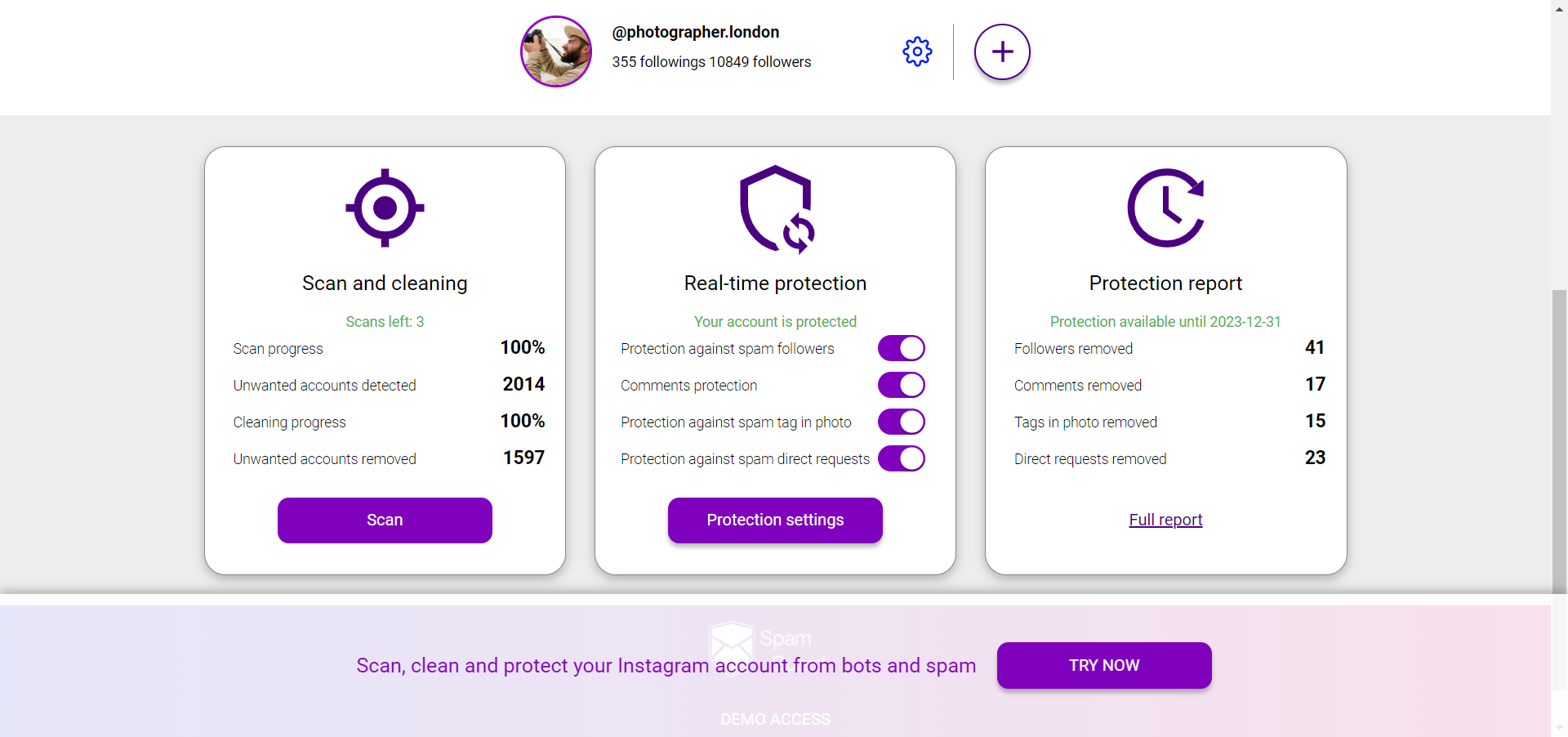
SpamGuard analyzes follower accounts against behavioral signals — posting activity, login recency, engagement patterns — and removes flagged accounts in safe batches. The result is a smaller but more engaged audience that responds better to every piece of content the strategy produces.
Run a free follower quality audit at SpamGuard before launching a new content strategy. Clean audience means the strategy's results are readable — when metrics improve, it is because the content is working, not because algorithm noise is masking the signal.
Review Cycle: The 90-Day Reset
A content strategy should be reviewed and adjusted every 90 days. By then, enough data exists to identify which pillars generate the most engagement, which formats produce the most followers, and which posting times drive the highest reach.
The review process:
This iterative cycle is what separates accounts that plateau after initial growth from accounts that grow continuously over years.
Conclusion
A content strategy is not a complicated document — it is a clear answer to four questions: what is the goal, what topics will the account cover, what formats will carry those topics, and how will success be measured. Accounts that answer these questions explicitly outperform accounts that post intuitively, at every follower count.
Before executing the strategy, verify that the audience quality supports it. Check your follower base at spamguardapp.com — a clean audience makes every content decision more effective.