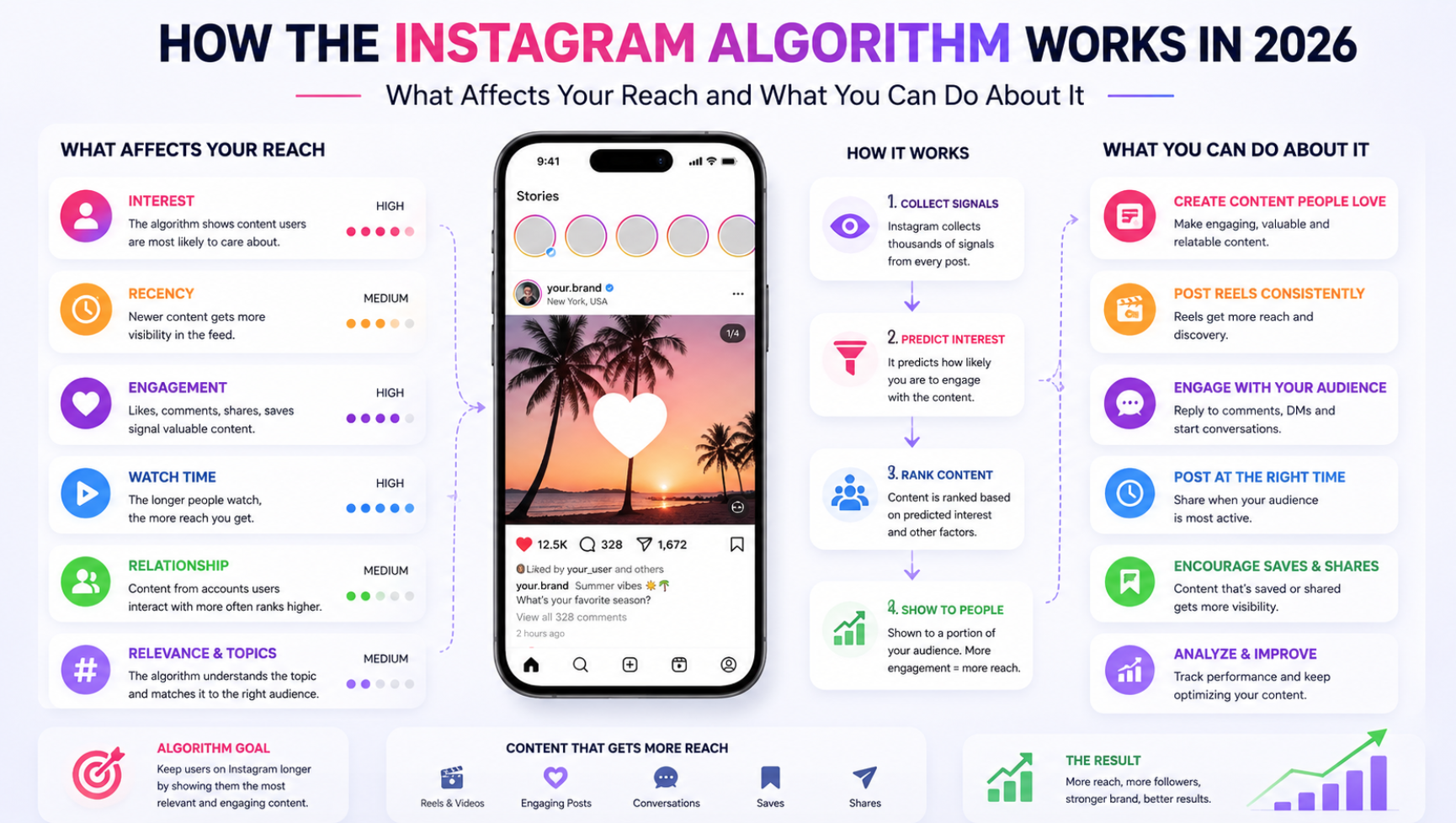
This guide covers how the algorithm works in 2026, which signals matter most, and what you can realistically do to improve your reach — including the audience quality factor that most creators overlook.
How Instagram Distributes Content: The Basic Model
When you publish a post, Instagram doesn't immediately show it to all your followers. Instead, it runs a prediction: how likely is each follower to engage with this post? Based on that prediction, it shows the post to a subset of your audience first.
If that initial group engages strongly — watching, liking, saving, sharing, commenting — the algorithm interprets the content as high-quality and distributes it more broadly: to more of your followers, then potentially to non-followers through Explore or Reels recommendations.
If the initial group doesn't engage, distribution stops. The post reaches only a fraction of your audience and essentially disappears.
This model has a critical implication: the quality of your audience matters as much as the quality of your content. If the initial sample the algorithm tests your post on is heavy with fake accounts, ghost followers, and inactive users who never engage — the early signals are weak, and your post gets buried even if it's excellent content.
Feed Algorithm: What It Prioritizes
Instagram has confirmed the key signals its Feed algorithm uses to rank content. In order of influence:
Post information. Popularity signals: how quickly the post is accumulating likes, comments, saves, and shares. Recency also matters — newer content gets a baseline boost.
Information about the person who posted. How often you've interacted with the account in recent weeks. Accounts you engage with regularly appear higher in your feed.
Your activity. What types of posts you've liked, saved, and commented on recently. The algorithm maps your interest patterns and shows you more of what matches them.
History of interaction. Whether you've previously interacted with this account and how much.
The practical implication: accounts whose followers regularly engage with their content get prioritized. This is why a declining engagement rate creates a compounding problem — lower engagement leads to lower reach, which leads to even lower engagement over time.
Reels Algorithm: The Highest-Reach Surface
Reels are distributed differently from Feed posts. Instagram pushes Reels to non-followers far more aggressively — it's the primary discovery surface in 2026. The algorithm's top signals for Reels distribution:
Watch-through rate. What percentage of viewers watch to the end, or watch again. A Reel that people replay gets promoted heavily. The first 2–3 seconds are critical — they determine whether someone keeps watching or scrolls.
Shares. When someone sends a Reel to a friend via DM, that's a very strong positive signal — it means the content was compelling enough to share personally.
Saves. Strong signal that the content has rewatch value or reference value.
Audio usage. Reels using trending audio get a distribution boost from the trend's momentum.
Avoid recycled content. Instagram actively deprioritizes Reels that are visibly re-uploaded from TikTok (with watermarks) or contain black bars from incorrect aspect ratios.
Stories Algorithm: Audience-First Distribution
Unlike Feed and Reels, Stories are shown almost exclusively to existing followers — Instagram doesn't push Stories to non-followers in any meaningful way. The Stories algorithm ranks whose Stories appear first in your tray based on:
How often you interact with an account's Stories (watch, reply, react)
Whether you've DMed the account recently
Whether you regularly interact with their Feed posts
For creators, this means Stories is a retention and relationship-building tool, not a discovery tool. Strong Stories engagement keeps you visible to existing followers and strengthens the relationship that makes them more likely to engage with your Feed and Reels content.
Explore and Search: Discovery for New Audiences
Explore surfaces content to users based on their historical interests and behavior. It's primarily driven by what's performing well among accounts and content similar to yours — the algorithm looks at what people who engage with your type of content also engage with.
Search has become more powerful in 2026 — Instagram now indexes captions and hashtags more thoroughly. Including specific, searchable terms in your captions (not just hashtags) can help your content appear in search results for relevant queries.
The Audience Quality Factor: What Most Creators Miss
Every algorithm surface — Feed, Reels, Explore — relies on engagement signals from your current audience to determine how broadly to distribute content. This creates a direct dependency between audience quality and content reach.
An account with 20,000 followers where 8,000 are bots or inactive ghost accounts is effectively working with an engaged base of 12,000. But the algorithm calculates distribution based on 20,000. When it samples your audience to test a post, a significant portion of that sample will never engage — not because they didn't like the content, but because they're not real or active users.
The result: lower early engagement signals, more limited distribution, lower organic reach — even for high-quality content.
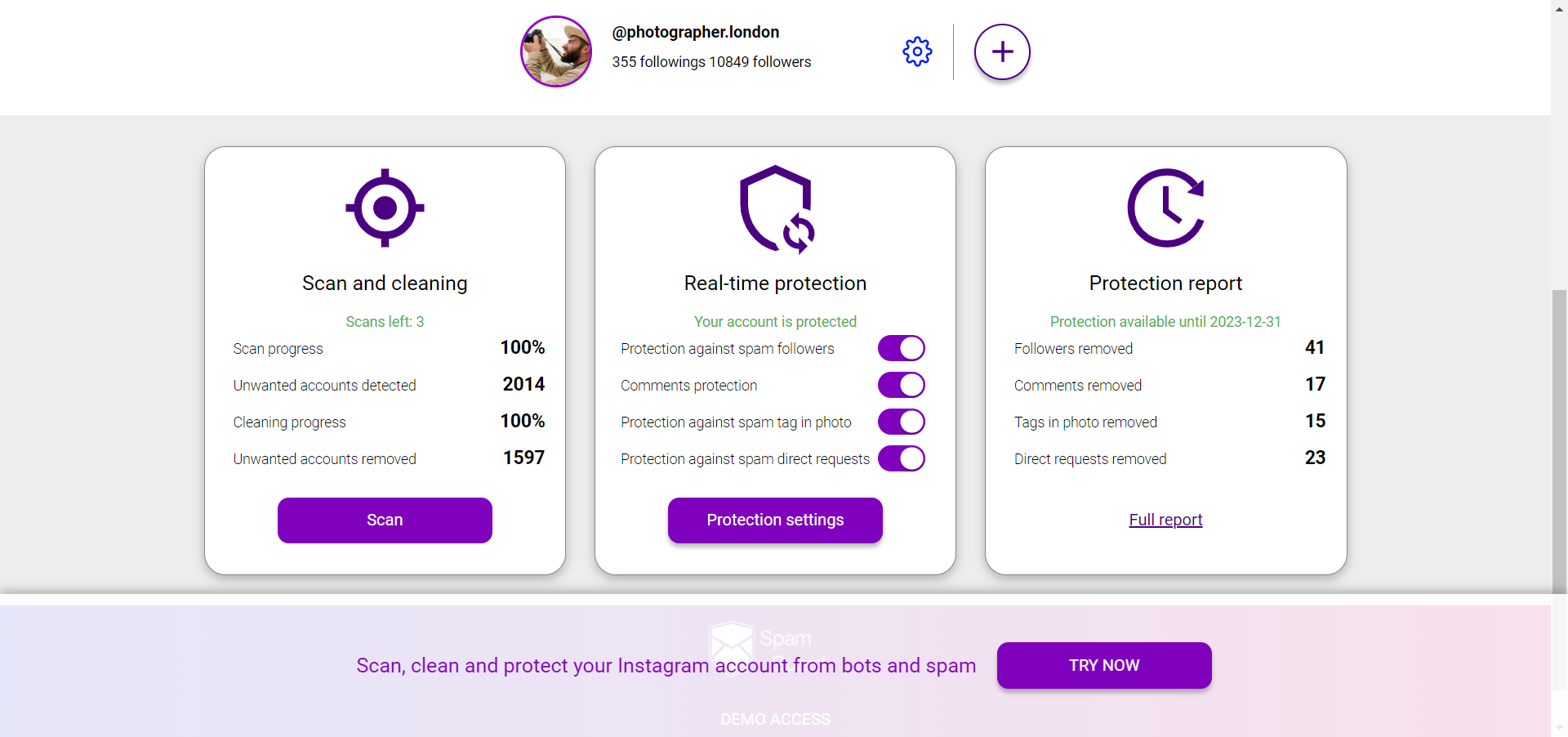
Cleaning your audience with SpamGuard addresses this directly. By removing fake accounts and inactive followers, you increase the proportion of real, potentially-engaging users in every algorithm sample. The same content, shown to a cleaner audience, produces stronger early signals — and gets distributed more widely.
What You Can Actually Control
Some algorithm factors are outside your control — you can't force Instagram to prioritize your content category, and platform-wide changes happen without notice. But several high-leverage factors are fully within your control:
Post at peak times for your specific audience. Check your Insights for when followers are most active. Peak engagement windows vary significantly by account — don't rely on generic advice.
Optimize for saves and shares, not just likes. These are the highest-weight engagement signals in 2026. Create content people want to save for later or send to someone.
Respond to comments quickly after posting. High comment velocity in the first hour signals active engagement to the algorithm.
Use native formats. Instagram consistently gives better distribution to content using its own features — Reels with original audio, carousels, Stories with interactive elements — over repurposed content from other platforms.
Maintain audience quality. Regular removal of fake and inactive accounts with SpamGuard keeps your engagement-to-follower ratio healthy — which keeps algorithm distribution working in your favor.
The algorithm rewards accounts that deliver genuine value to real audiences. Everything else — posting frequency, hashtag strategy, posting times — is secondary to having content worth engaging with and an audience capable of engaging with it.