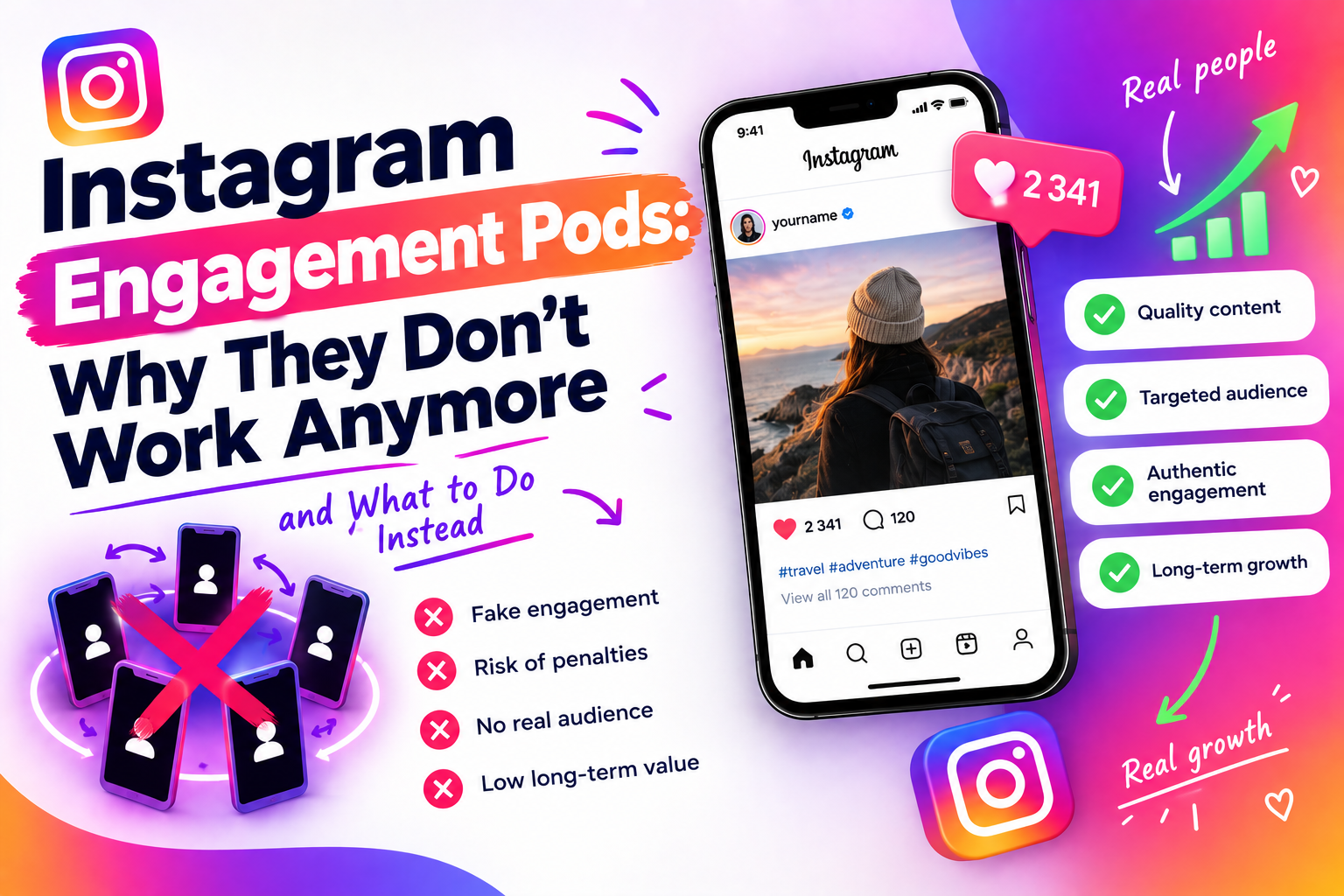
Engagement pods — private groups where members coordinate to like and comment on each other's posts immediately after publishing — were a popular growth tactic from roughly 2017 to 2021. The underlying logic was algorithmically sound for its time: Instagram's early algorithm weighted raw engagement counts in the first hour after posting, so coordinated activity from pod members pushed posts into broader distribution.
In 2026, that logic no longer holds. Instagram's algorithm has evolved substantially, and engagement pods now produce results that range from ineffective to actively harmful. Understanding exactly why requires a detailed look at how the algorithm changed, what signals it now uses, and what actually works in their place.
How Engagement Pods Were Supposed to Work
The original engagement pod model exploited a straightforward property of Instagram's early recommendation system. When a post received a burst of likes and comments in its first 30 to 60 minutes, the algorithm interpreted this as evidence of high quality and distributed the post to a wider audience.
Pod members would receive a notification or message when a post went live, then immediately visit and engage with it. The resulting engagement spike triggered algorithmic amplification. For accounts in the same niche, this felt like a legitimate growth strategy — members genuinely belonged to the same community, even if the timing of their engagement was coordinated.
At its peak, well-organised pods with 15 to 30 highly engaged members in the same niche could meaningfully increase post reach. Some accounts built significant audiences using pods as their primary growth mechanism.
How Instagram's Algorithm Changed
Meta began addressing pod-driven engagement inflation through a series of algorithm updates starting in late 2020. By 2023, the detection systems had become sophisticated enough to identify and discount coordinated engagement at scale. In 2026, the current system evaluates engagement across multiple dimensions simultaneously:
Identity Context and Relationship Signals
The algorithm now analyses the relationship between an engaging account and the content it engages with. A like or comment from an account that has previously engaged with similar content, follows accounts in the same niche, and has an established engagement history with the creator carries significantly more weight than the same action from a pod member whose content interests are unrelated.
Pod members who engage across many different niches — because their pod includes creators from different categories — produce engagement signals that the algorithm identifies as contextually mismatched. A fitness creator receiving comments from a food blogger, a technology reviewer, and a travel photographer all within minutes of posting triggers anomaly detection.
Behavioural Pattern Recognition
Instagram's systems monitor the timing and sequence of engagement actions. Human users engage with content at irregular intervals, with natural variation in how quickly they respond to posts. Pod members, by contrast, typically engage within a tight window — often within 15 to 30 minutes of posting, because they received the pod notification.
When multiple accounts engage with the same post within a narrow time window, especially accounts that show similar coordinated behaviour across other posts, the pattern is flagged. The engagement may be discounted entirely or weighted at a fraction of its nominal value.
Comment Quality Analysis
Instagram uses natural language processing to evaluate comment relevance and specificity. Generic pod-style comments — emoji strings, single words like 'Amazing!' or 'Great post!', and templated phrases — are identified as low-quality engagement signals and weighted accordingly.
This is a significant shift from 2018 conditions, when any comment counted equally regardless of content. In 2026, a single substantive comment that references specific content in the post can outweigh ten generic pod comments in the algorithm's quality assessment.
Cross-Account Network Mapping
Perhaps the most significant development is Instagram's ability to map engagement networks. The algorithm tracks which accounts consistently engage with each other's content, how often their engagement correlates with posting timestamps, and how their mutual engagement compares to their engagement with non-pod accounts.
Accounts that participate in multiple pods, or have participated historically, build a detectable engagement network signature. Even when the account is no longer actively in a pod, the historical pattern affects how the algorithm weighs current engagement.
The Shadowban Connection
Accounts with strong pod participation histories frequently experience reduced algorithmic distribution — commonly referred to as a shadowban. This manifests as posts that receive normal engagement from followers but fail to appear in hashtag feeds, Explore, or Reels recommendations, despite meeting all other quality criteria.
The mechanism: the algorithm identifies the coordination pattern, reduces its confidence in the account's authentic engagement signals, and applies a distribution multiplier that limits reach outside the existing follower base. The account continues to function normally in every visible way, but its organic reach potential is significantly curtailed.
Shadowban recovery typically requires a sustained period of organic, uncoordinated engagement — often three to six months — during which the algorithm rebuilds a clean engagement signal baseline for the account.
What Pods Cannot Fix: The Audience Quality Problem
Even setting aside the algorithmic detection issue, engagement pods address the wrong problem. The fundamental challenge for most Instagram accounts is not a lack of engagement in the first hour — it is an audience quality problem that suppresses all engagement metrics regardless of coordination.
Accounts that have grown through follow-for-follow campaigns, post-viral follower spikes, or accumulated bot followers over time contain a large proportion of ghost followers: accounts that are inactive, have become bots, or never had genuine interest in the content. These ghost followers do not engage regardless of content quality. They dilute the engagement rate by inflating the denominator — the total follower count — while contributing nothing to the numerator.
An account with 10,000 followers and 3,000 ghost followers has an effective audience of 7,000. But the algorithm measures engagement against 10,000. The resulting engagement rate — say, 2% — looks like a content problem or an algorithm problem. In reality, it is an audience quality problem. No pod can compensate for it, because even coordinated engagement from pod members does not change the underlying audience composition.
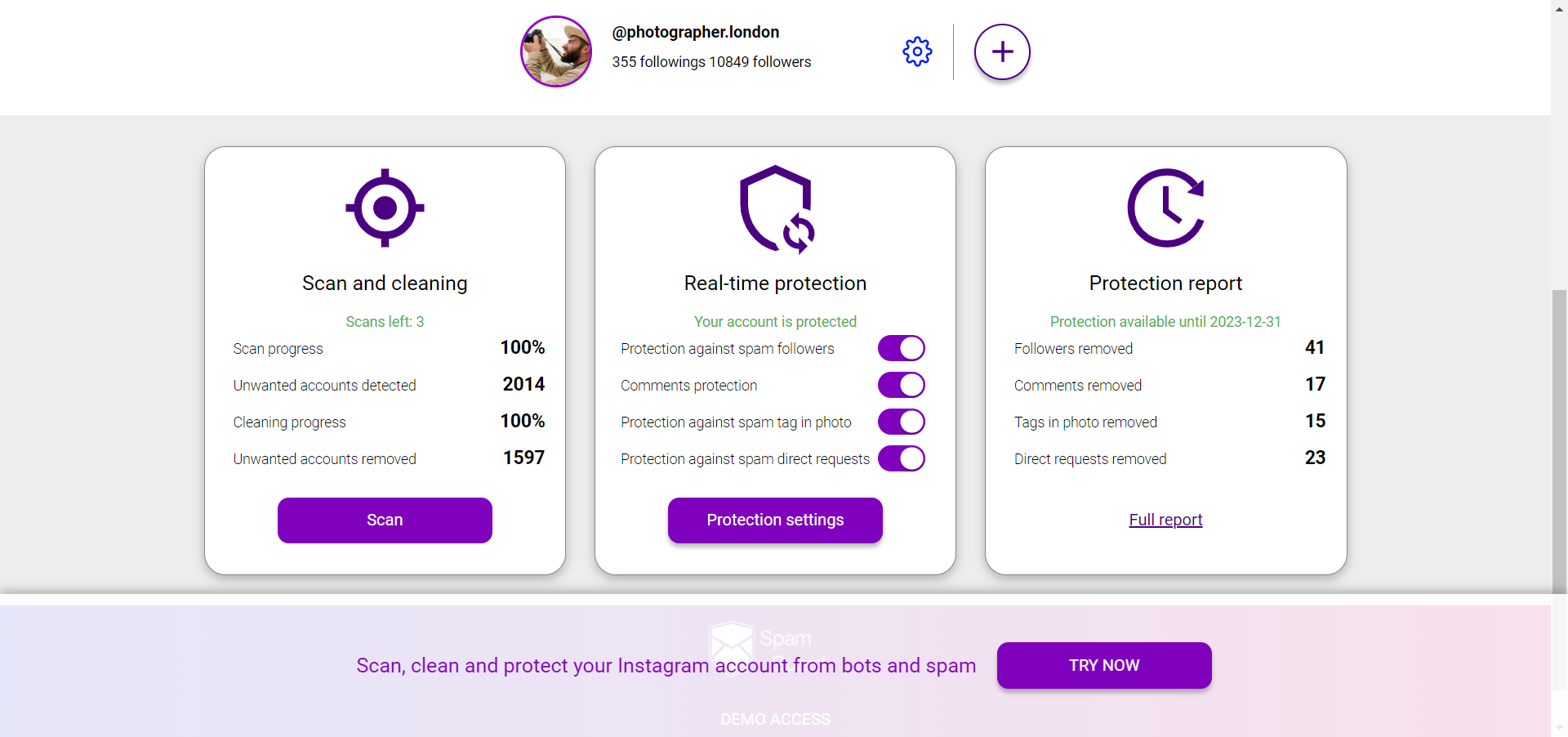
SpamGuard addresses this directly by identifying ghost followers, bot accounts, and chronically inactive profiles through behavioural analysis — posting frequency, login recency, engagement patterns, account age — and removing them safely. After cleanup, the engagement rate reflects the actual quality of the remaining audience, and every piece of content performs against a realistic denominator.
Run a free follower quality audit at SpamGuard before investing further in any engagement strategy. Audience quality is the foundation that determines whether any approach — pods or otherwise — can deliver consistent results.
What Actually Works in 2026
Saves-Optimised Content
Saves are the highest-weighted engagement signal in Instagram's current algorithm. Unlike likes, which can be given passively, saves require the viewer to make an active decision that the content is worth returning to. The algorithm treats saves as a strong indicator of genuine value — content that generates saves consistently receives preferential distribution over time.
Content that generates saves reliably tends to be: step-by-step guides, resource compilations, comparison frameworks, checklists, and reference material that viewers want to access again. The format matters less than the functional value — a carousel, a Reel, or a single image can all generate saves if the content is genuinely useful.
Genuine Community Building Through Responses
Responding to every comment within the first two hours of posting increases comment thread depth and maintains the post's algorithmic momentum. This is organically authentic — real engagement from real followers — and it signals to the algorithm that the post is generating active conversation.
Beyond the algorithmic benefit, responding to comments builds the kind of community relationship that drives long-term follower retention. Followers who receive a genuine response are more likely to engage with future posts, creating a compounding improvement in organic engagement rates.
Shareable Reels and Content
Shares — particularly Reels shares — are the most powerful distribution signal because each share extends reach to non-followers. Content that generates shares is typically one of three types: content that makes the sharer look knowledgeable when they pass it on, content with information specifically relevant to a particular network, or content with a strong emotional resonance.
Designing explicitly shareable content — where the viewer's motivation to share is built into the content concept, not just hoped for — produces more reliable share rates than general content quality improvements.
Strategic Collabs
Instagram's Collab feature allows two accounts to co-author a post or Reel that appears on both profiles simultaneously. A well-matched Collab with an account that serves the same audience from a complementary angle produces genuine cross-audience engagement — viewers engaging because they are actually interested, not because they are fulfilling an obligation.
This is what pods were attempting to achieve — cross-audience exposure — but through a legitimate, algorithm-supported mechanism rather than coordinated deception. The algorithm does not discount Collab engagement because it is not coordinated in a detectable way; each account's followers engage independently based on genuine interest.
Conclusion
Engagement pods represent a solution to a problem that Instagram's algorithm no longer has. The coordination patterns they produce are now detectable, the engagement they generate is weighted at a discount, and the accounts that use them risk suppressed distribution that can take months to recover from.
The more productive path is addressing the actual drivers of engagement underperformance: content that generates saves and shares, genuine community interaction, and a clean follower base that gives the algorithm accurate quality signals.
If engagement rates remain low despite content improvements, the underlying cause is almost always audience quality. Check your follower base for ghost followers and bot accounts at spamguardapp.com.